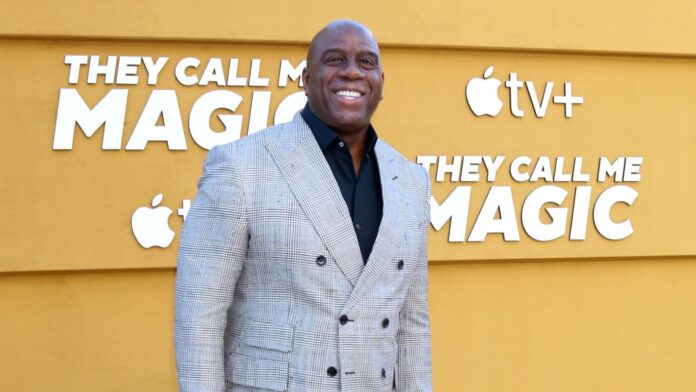
Some players change how a position is played. Magic Johnson changed what a position even means. Point guards were supposed to be small, quick, and limited in scope. Their job was to pass the ball and stay out of the way. Then a 6’9″ kid from Lansing, Michigan, arrived and made every rule look ridiculous.
Magic Johnson transformed the point guard position, challenging conventional wisdom and reshaping how coaches, scouts, and players viewed the game. His exceptional skills and vision redefined the role, and decades later, his influence remains evident in the modern NBA, leaving a lasting legacy on basketball as we know it.
Keep reading to find out exactly how he did it.
A size nobody had seen at point guard
Magic Johnson broke every unwritten rule about how tall a point guard was allowed to be. Before Magic, tall lead guards were rare, but they already existed. Oscar Robertson was a 6-foot-5 primary ball-handler and is described by NBA.com as the first “big guard” who laid the foundation for players such as Magic Johnson.
Magic showed up at 6’9″ and 215 pounds, a size reserved for power forwards. He saw over every defender on the floor. That height gave him passing angles nobody else could find. The entire concept of the position changed the moment he touched the court.
The rookie year that stunned the entire league
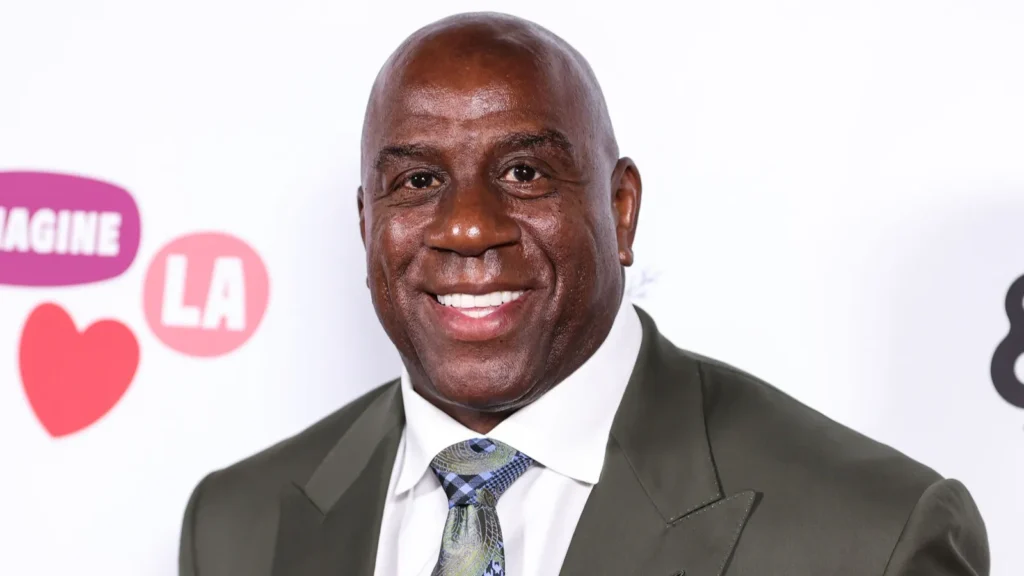
No first-year player had ever done what Magic did in Game 6 of the 1980 NBA Finals. Kareem suffered a sprained ankle in Game 5 and missed Game 6, which led the Magic to start at center and play every position. He posted 42 points, 15 rebounds, and 7 assists to clinch the title for Los Angeles.
That performance remains the highest-scoring game by a rookie in NBA Finals history. He became the first-year player to ever win Finals MVP. The entire basketball world realized this was something the sport had genuinely never seen before. He was only 20 years old.
Fun fact: Magic Johnson got his nickname ‘Magic’ from a Lansing sportswriter after a high school game in which the 15-year-old posted 36 points, 16 rebounds, and 16 assists in a single night
The Showtime offense was built around his vision
Magic did not run the fast break. He conducted it like an orchestra. The Showtime Lakers were built on one key ingredient: Magic Johnson’s ability to push the pace. He would grab a defensive rebound, race up the floor, and thread passes through traffic nobody else could see. His no-look passes became a trademark of the entire era.
In a typical sequence, he would race ahead of defenders and find teammates with pinpoint outlet passes for easy layups. Opponents could not prepare for a point guard who ran the floor like a forward. The fast break became an art form whenever Magic had the ball.
Passing numbers that still stand alone
His assist records tell the story of a player who made everyone around him better every single night. Magic led the NBA in assists four separate seasons throughout his career.
Magic finished with 10,141 career assists, but that was not the all-time record at his final retirement. At his initial 1991 retirement, he was the all-time assists leader with 9,921, and John Stockton passed that mark in 1995.
He is the only player in NBA history to average at least 20 points and 12 assists per game in two separate seasons. That combination of scoring and playmaking had no comparison. Point guards before him were asked to pass. Magic was asked to control an entire game by himself.
The rivalry with Bird that saved the NBA
When Magic arrived in 1979, the NBA was struggling. Attendance was declining, and TV ratings were soft. Then, Magic’s Lakers and Larry Bird’s Celtics started meeting in the Finals repeatedly. The league was worried about declining attendance and TV ratings before that rivalry ignited. Their games pulled the sport into primetime and kept it there.
The two men had first met in the 1979 NCAA Championship game, the most-watched college game in history. That rivalry carried straight into the NBA and gave the league a coast-to-coast story. Fans picked sides. Cities became passionate. Basketball became must-watch television across the entire country.
Five championships that proved the formula worked
Winning once can be luck. Winning five times is a system, and Magic was the engine of that system. The Lakers won five NBA championships during Magic’s time with the team in 1980, 1982, 1985, 1987, and 1988. He earned three Finals MVP awards along the way. The Lakers averaged 59 wins per season during the Magic era, posting one of the great sustained runs in professional sports history.
The 1988 championship was particularly historic. Los Angeles became the first NBA team to win back-to-back titles since the Boston Celtics in 1969. Magic drove that repeat by maintaining the same high standard across an entire decade. Few point guards in NBA history have matched Magic’s level of sustained championship production, as he led the ‘Showtime’ Lakers to five titles and earned three Finals MVP awards.
Fun fact: In the 1982 NBA Finals, Magic won the MVP award while averaging just 16.2 points per game. That remains the lowest scoring average by any Finals MVP in the three-point era, proving he dominated without needing to score.
A legacy that ESPN ranked above everyone else
ESPN rated Magic Johnson the greatest point guard of all time in 2006, stating he may be the one player in NBA history who could be argued as better than Michael Jordan. He was inducted into the Naismith Memorial Basketball Hall of Fame in 2002 and named to the NBA 75th Anniversary Team in 2021.
He was also a 12-time All-Star, three-time league MVP, and an Olympic gold medalist with the 1992 Dream Team. His career average of 11.2 assists per game has never been surpassed. When the full body of work is considered, no point guard in history left a bigger mark on how the position is played, understood, and valued.
TL;DR
- Magic Johnson arrived at 6’9″ and shattered the rule that point guards had to be small players.
- His 42-point Game 6 remains one of the greatest rookie playoff performances ever and the highest-scoring NBA Finals game by a rookie.
- He led the NBA in assists four times, and his 11.2 career assists per game average has never been matched.
- The Showtime Lakers won five championships in the 1980s with Magic as the engine of the offense.
If you liked this story, don’t forget to follow us for more exclusive content.
This article was made with AI assistance and human editing.
If you liked this, you might also like: