
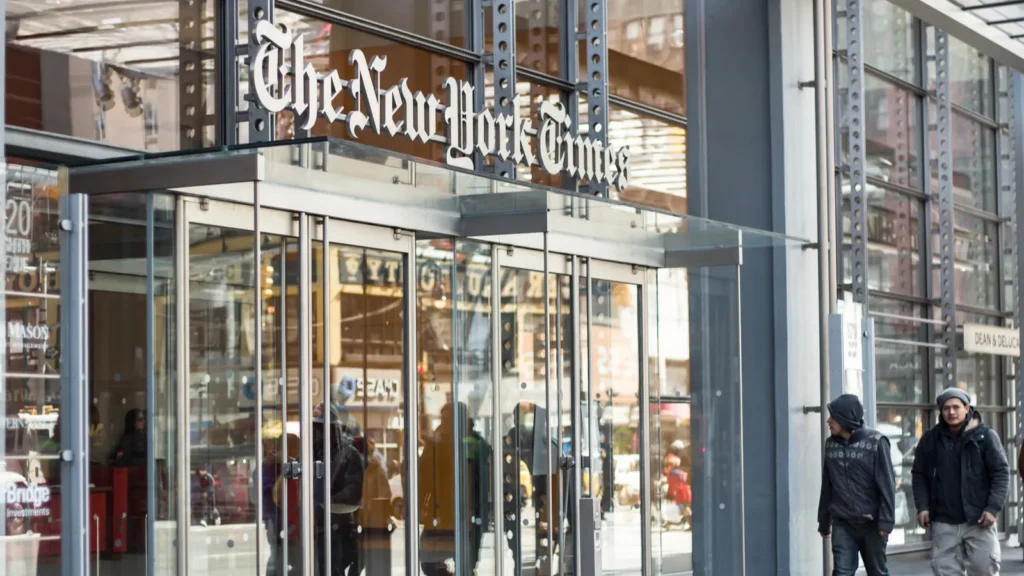
An Alabama jury has ordered The New York Times to pay $9.25 million in damages to former University of Alabama basketball player Kai Spears after finding that the newspaper defamed him by incorrectly reporting that he was at the scene of a fatal January 2023 shooting. Spears was a freshman walk-on at the time, and the Times identified him as a passenger in a car involved in the shooting.
The newspaper later corrected the report after Spears filed a lawsuit. The verdict marks the Times’ first U.S. defamation loss involving one of its articles in more than 50 years.
The report relied on a confidential source
Times sportswriter Billy Witz published a story on March 15, 2023, about the deadly January shooting in Tuscaloosa. The Times relied on information from 2 confidential sources, with one source identifying Kai Spears as the passenger in Brandon Miller’s car.
Witz testified that he considered the source knowledgeable because of the person’s professional position and access to information about the case. The story identified Spears as the previously unidentified passenger in the vehicle.
The report said bullets struck the car while Miller and the passenger escaped unharmed. Spears was not at the scene. The person in the vehicle was Cooper Lee, a student manager for the Alabama basketball team.
Spears was identified in the report
Spears was 18 years old when the Times published the article identifying him as the passenger in Brandon Miller’s car. He was a freshman walk-on for Alabama at the time. The report incorrectly linked him to the January 2023 shooting that killed 23-year-old Jamea Harris.
Spears publicly said the report was inaccurate, and his father, Christian Spears, also rejected it. Alabama Athletics likewise said Spears was not present at the shooting.
Christian Spears was Marshall University’s athletic director when the article was published. He left that position after the university announced in April 2025 that his contract would not be renewed.
The verdict ends a more-than-50-year streak
The New York Times has reported on major American news events for more than a century. According to the newspaper, it had not lost a U.S. defamation lawsuit involving one of its articles in more than 50 years before the Spears verdict.
The verdict ended that streak, with the jury awarding Spears $9.25 million in damages after a nine-day trial. A Times spokesperson said the newspaper was disappointed by the decision, describing the underlying error as an honest mistake rather than actual malice, and said the company was reviewing its legal options.
Spears’ attorney said the verdict should push journalists to be more careful about source verification going forward.
Jury awards Spears $9.25 million
The case went to trial in the U.S. District Court for the Northern District of Alabama in Tuscaloosa. An 8-person jury reached its verdict after a 9-day trial. Spears alleged that the false report caused emotional distress and reputational harm.
His lawyers argued that the Times failed to use reasonable care before publishing the story. The jury found that the Times defamed Spears and awarded him $9.25 million in damages.
The $9.25 million award included compensatory and punitive damages. Under Alabama law, the damages award in this case is expected to be reduced.
Alabama has a key place in defamation law
Alabama was the setting for a landmark U.S. Supreme Court defamation case, New York Times Co. v. Sullivan, decided in 1964. The ruling established the “actual malice” standard for public officials, requiring proof that a statement was knowingly false or made with reckless disregard for the truth, and the Supreme Court later extended that standard to public figures.
Private individuals generally receive different constitutional protections in defamation cases. In Spears’ case, a federal judge determined that he was a private figure, and the case was litigated in the same Alabama courts where the events underlying Sullivan’s case had occurred nearly six decades earlier.
Fun fact: Miller was selected Second overall by the Charlotte Hornets in the 2023 NBA Draft.
The case highlights issues with confidential sourcing
The Spears case centered on the New York Times’s use of confidential sources when identifying the passenger in Brandon Miller’s car. Witz testified that he considered Source A knowledgeable because of the person’s professional position and access to information about the case.
The Times’ reporting relied on 2 confidential sources, but Source A provided the information identifying Spears. The Times initially stood by the report after Spears and his father denied that he was present.
After Spears filed his lawsuit, the newspaper conducted additional reporting and determined that the passenger was Cooper Lee, a student manager for the team. The Times published an editor’s note correcting the article on June 2, 2023, 3 days after Spears filed his lawsuit on May 30.
The Times reviews its legal options
A New York Times spokesperson said the newspaper was disappointed by the jury’s decision and believed the verdict and damages award were contrary to the law and unsupported by the evidence. The Times said it was reviewing its legal options after the verdict.
The newspaper has not publicly confirmed that it will appeal. If an appeal is filed, the case could proceed to a federal appeals court, where the verdict or damages award could be reviewed. The final amount could change if the damages award is reduced under applicable Alabama law or altered on appeal.
The parties may continue to pursue legal proceedings following the jury’s verdict. The verdict could be considered in future discussions involving defamation claims against news organizations.
The verdict raises questions about confidential-source reporting
The case centered on an inaccurate identification of Spears based on confidential-source information, resulting in a $9.25 million jury award against The New York Times. Spears said he hoped the verdict would encourage journalists to verify information carefully before publication and protect future athletes from similar harm, according to ESPN.
The case has also drawn broader attention to how newsrooms use and verify confidential sources when reporting on active criminal investigations. Separately, Michael Davis, who was convicted of capital murder in the January 2023 shooting that killed Jamea Harris, was sentenced to life in prison without the possibility of parole in May 2025.
Little-known fact: Michael Davis was convicted of capital murder in connection with Harris’ death and sentenced to life in prison without parole.
TL;DR
- A jury awarded Kai Spears $9.25 million in damages.
- The Times wrongly identified Spears as the passenger.
- Cooper Lee was the actual passenger, not Spears.
- The verdict ended the Times’ more-than-50-year defamation streak.
- The Times is reviewing its legal options.
If you liked this story, don’t forget to follow us for more exclusive content.
This article was made with AI assistance and human editing.
If you liked this, you might also like: