

Alexander Zverev’s second-round match against Quentin Halys at the 2026 US Open produced one of the tournament’s more unusual moments when Zverev stopped during a crucial third-set game to change his shoes.
The incident drew attention because Halys was leading 4-1 and had two break points when Zverev asked to make the change. The chair umpire allowed it after warning that the timing was not ideal.
The unusual stoppage quickly became a talking point, with debate centering on the rules governing equipment problems and whether the timing gave Zverev any competitive advantage.
A nightmare start for the top seed
Alexander Zverev entered the 2026 US Open as the top seed after world No. 1 Jannik Sinner withdrew with a right knee injury. Zverev was coming off his first Grand Slam title at Roland Garros and a runner-up finish to Sinner at Wimbledon.
His opening match in New York was a major test. He needed five sets to defeat Lorenzo Sonego, 6-4, 3-6, 6-7(7), 7-5, 6-4, in 4 hours and 53 minutes, with the match ending at 1:55 a.m.
The victory kept Zverev from becoming the first top seed in the men’s singles draw to lose in the opening round of a Grand Slam since Lleyton Hewitt was beaten by Ivo Karlovic at Wimbledon in 2003.
The shoe change that stopped everything
Two days later, Zverev faced Frenchman Quentin Halys in the second round. Trailing 4-1 in the third set, Zverev stopped play while Halys held two break points and asked to change his shoes.
The chair umpire warned him about the timing but allowed the change. The umpire told Zverev, “It would be better if you didn’t do it now.” Zverev replied, “Can I? Quickly?” before receiving permission to make the footwear change.

What the obscure rule really says
The rules give the chair umpire discretion in equipment-related situations. At Grand Slam tournaments, provisions for “equipment out of adjustment” can apply when a player’s equipment becomes unplayable, with the chair umpire deciding each request on its merits.
The 2026 ATP Rulebook also specifically says a chair umpire may allow a reasonable extension during a changeover for a player to change shoes or socks. In Zverev’s case, he asked before changing his shoes, and the umpire allowed the request.
The timing drew attention because Halys was leading 4-1 in the third set and had two break points. Whether the stoppage created a competitive advantage is a matter of interpretation, but the rules give officials discretion over equipment-related situations.
Andy Roddick breaks down the moment
Former US Open champion Andy Roddick offered his view of the controversy, focusing less on the timing of the stoppage and more on the equipment issue itself.
Roddick said Zverev’s asking the umpire before making the change was significant. He argued that a player with an equipment problem can change shoes when necessary and questioned whether Zverev would have stopped play if there had not been a genuine problem.
Roddick also pushed back against the idea that Zverev was deliberately using gamesmanship, saying, “We don’t often see Sascha using gamesmanship.”
The strange link to Jodar’s shoes
Roddick also pointed to a connection with Rafael Jódar, whose footwear problems had become a talking point during the North American hard-court swing.
During the Cincinnati Open, Jódar stopped twice after his shoelaces broke while he was facing Denis Shapovalov. The interruptions became part of the controversy surrounding the match, which Jódar ultimately won after trailing 5-1 in the deciding set.
Jódar was asked about the shoelace discussion after his first-round loss at the US Open and appeared frustrated by the question. He repeatedly questioned what the reporter was asking and said the question did not make sense.
The shoe change quickly became a talking point among tennis fans because it came while Halys was serving with two break points at 4-1 in the third set. Reports and social-media discussions focused on whether the timing was gamesmanship or simply an equipment issue.
The match eventually finished at about 2:15 a.m., giving Zverev consecutive five-set victories that both ended deep into the night.
Little-known fact: Zverev has lived with type 1 diabetes since childhood but only revealed his diagnosis publicly in 2022, admitting he used to inject insulin privately in bathrooms so nobody would see.
Zverev fights back to win
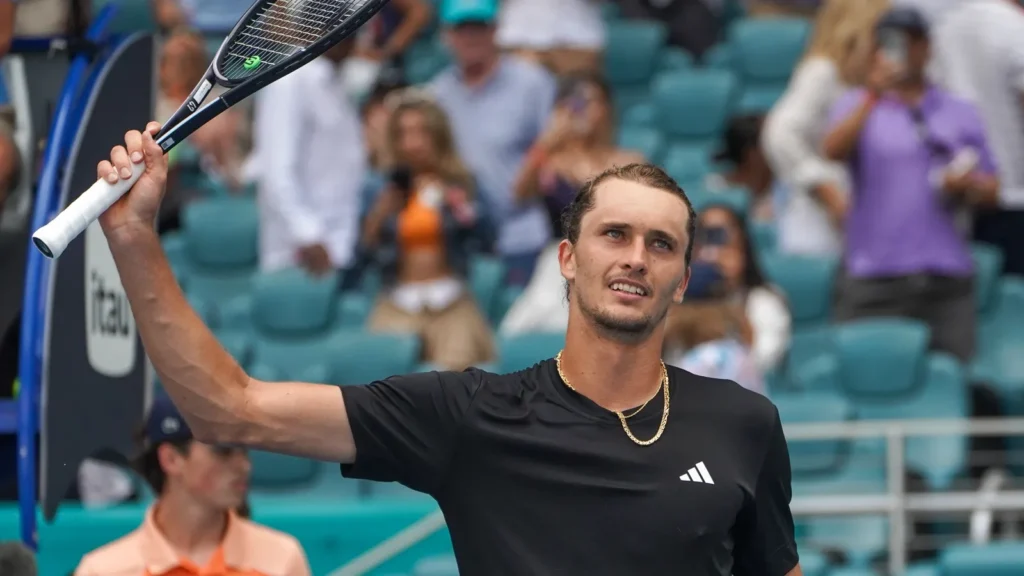
After changing his shoes, Zverev returned to the court and broke Halys’ serve to cut the Frenchman’s lead to 4-3. He then held serve to level the third set at 4-4. Zverev went on to take the third set 7-6(3), but Halys responded by winning the fourth-set tiebreak 7-6(3).
Zverev ultimately recovered to win the deciding set 6-3. Zverev’s victory was his second consecutive five-set win at the 2026 US Open, sending him into the third round after another four-hour-plus battle.
What comes next for Zverev
Zverev’s US Open opportunity has already carried him into the fourth round after he defeated Alejandro Tabilo 6-2, 7-6(2), 6-2. He is now scheduled to face No. 21 seed Luciano Darderi for a place in the quarterfinals.
Zverev has already won his first Grand Slam title at Roland Garros this year and reached the Wimbledon final, where he lost to Jannik Sinner. A US Open title would give him a second major championship of the season.
Little-known fact: Zverev speaks German, Russian, and English fluently, a direct result of his family’s move from Russia to Germany in 1991 and his years competing internationally.
TL;DR
- Zverev stopped play to change soaked shoes while facing two break points against Quentin Halys.
- The umpire warned him against the timing but allowed it.
- Andy Roddick clarified Zverev did not even need to ask, since equipment issues allow a change anytime.
- The moment echoed Rafael Jodar’s earlier shoelace controversy involving a similar shoe model this season.
If you liked this story, don’t forget to follow us for more exclusive content.
This article was made with AI assistance and human editing.
If you liked this, you might also like: