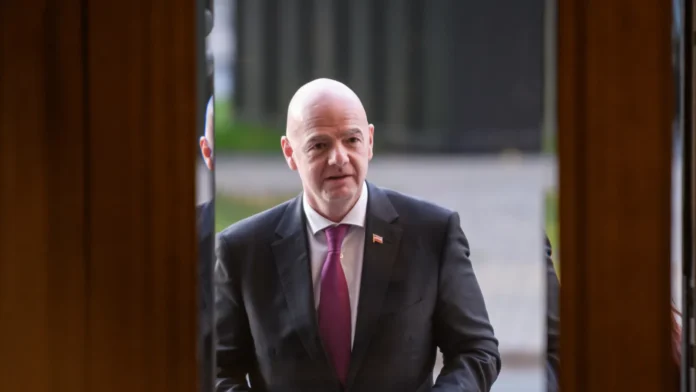
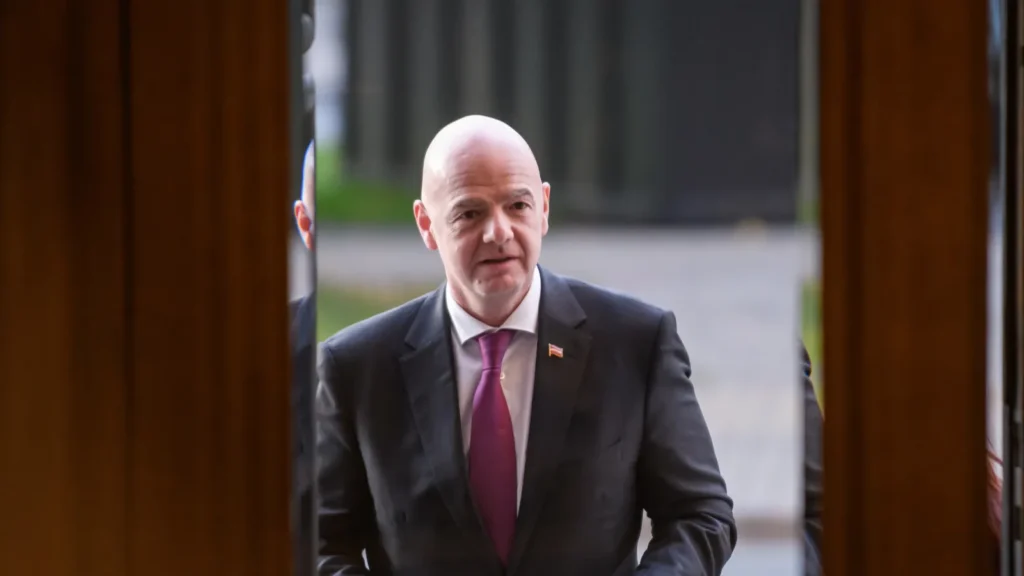
Gianni Infantino has led FIFA uncontested since 2016, but his decade-long grip on power is facing an unprecedented institutional crisis this month. The human rights organization FairSquare has formally petitioned FIFA’s Governance Committee to bar him from running in the March 2027 election, arguing he has already reached his three-term limit.
This legal challenge follows an immense political backlash that forced Infantino to scrap a secretive $20 billion commercial subsidiary plan to sell a $4.2 billion stake in World Cup commercial rights to private equity investors.
The fallout has triggered a civil war within football’s governing bodies, prompting UEFA, the Scottish FA, and several major European federations to completely withdraw their support for his presidency.
Rights group challenges Infantino’s fourth term
Human rights organization FairSquare has asked FIFA to rule Gianni Infantino ineligible to run for another presidential term, arguing that his first period in office should count toward FIFA’s three-term limit.
Infantino has led FIFA since 2016 and won reelection in 2019 and 2023 without opposition candidates. If he wins another election in 2027, he would remain FIFA president through 2031.
FairSquare argues that FIFA’s 2022 interpretation of the term-limit rule weakened the organization’s governance safeguards.
Understanding FIFA’s presidential term limit rules
FIFA statutes are actually quite simple on this particular matter. No person may serve as president for more than three terms of office, and the rule makes no clear exceptions for anyone.
The problem is that FIFA’s own governing Council decided back in 2022 that Infantino’s very first stretch in charge should not officially count toward the overall three-term limit under any circumstances.
That decision meant Infantino was officially treated as having only begun his own term count back in early 2019. FairSquare insists that this reading directly contradicts the plain language of FIFA’s own founding governance documents.
How Infantino’s first term became contested
Infantino first took charge of FIFA in February 2016, right after Sepp Blatter suddenly resigned amid a massive corruption scandal that shook global football to its very core and severely damaged its public reputation.
Because Infantino was technically finishing Blatter’s interrupted mandate rather than starting an entirely fresh one of his own, FIFA later argued that this partial period should never be formally counted toward his total term.
Miguel Maduro, the former head of FIFA’s own independent Governance and Review Committee, has publicly stated that the underlying rule here is completely clear, leaving very little genuine room for interpretation.
Inside the scrapped $20 Billion plan
Earlier this year, Infantino quietly proposed selling roughly a fifth of a brand-new commercial subsidiary, worth about 20 billion dollars in total, to outside private investors.
The plan would have handed a sizable minority stake in lucrative World Cup commercial rights to Thrive Capital, a venture capital firm founded by Joshua Kushner, a close relative of President Donald Trump by marriage.
Facing fierce and swift public backlash from several major football confederations around the world, FIFA ultimately scrapped the whole proposal in late July, though the wider controversy surrounding it has not fully faded away.
Confederations turn against FIFA’s leadership
UEFA, the Asian Football Confederation, and CONCACAF jointly demanded a formal independent review of Infantino’s overall conduct after FIFA’s private investment plan became public knowledge earlier last month, sources familiar with the matter told reporters.
UEFA alone represents 55 separate national member associations across Europe, giving the confederation enormous institutional weight whenever it chooses to speak out publicly and forcefully against FIFA’s leadership.
These three confederations together represent a truly massive share of FIFA’s worldwide membership, and their combined objection carries real institutional weight within football’s often complicated governance structure and decision-making process.
Little-known fact: Infantino’s current annual salary and bonus package reportedly sit around $6 million, quite modest when compared to the massive $20 billion valuation floated for the proposed new venture itself.
Scottish Football Association joins the opposition
The Scottish Football Association publicly confirmed it would formally oppose Infantino’s reelection bid, becoming one of the more prominent European national federations to openly break ranks with FIFA’s current leadership today.
Its decision came on the very same day that FairSquare officially submitted its own formal complaint, adding fresh momentum to a growing wave of institutional skepticism toward Infantino’s continued presidency of world football.
Not every federation agrees with this growing opposition, though. CONMEBOL, South America’s own governing body, has already publicly pledged its full, unanimous support for Infantino ahead of any official vote scheduled next year in Morocco.
What FairSquare’s formal letter actually argues
FairSquare sent its formal letter to FIFA’s own Governance, Audit, and Compliance Committee on August 13, requesting that the committee rule Infantino totally ineligible for reelection.
The letter states quite plainly that neither FIFA’s own statutes nor its governance regulations ever allow any single presidential term to be discounted simply because that particular term happened to run a little bit shorter.
FairSquare director Nicholas McGeehan personally told reporters that the complaint provides very clear and quite compelling evidence of a serious rule violation, one that sets a genuinely dangerous precedent for football governance worldwide.
What comes next for FIFA’s election
FIFA will formally elect its next president at the annual Congress in Morocco on March 18, 2027, and Infantino remains the only publicly declared candidate for that vote so far.
The Governance, Audit and Compliance Committee must now carefully and formally decide whether FairSquare’s eligibility challenge actually carries any real legal weight under FIFA’s existing statutes and internal governance bylaws currently in force.
Whatever the committee ultimately decides in the coming months, the outcome will likely shape how future FIFA presidents interpret these term limits for decades across the entire sport of football worldwide.
Fun fact: Soccer isn’t Gianni Infantino’s only major title. He was elected to the International Olympic Committee in January 2020, expanding his influence well beyond FIFA.
TL;DR
- FairSquare formally asked FIFA to rule Infantino ineligible for a fourth presidential term.
- FIFA statutes cap presidents at three terms, with no stated exceptions.
- A 2022 FIFA Council decision excluded Infantino’s first, partial term from that count.
- Infantino has led FIFA since 2016 and would serve through 2031 if reelected.
If you liked this story, don’t forget to follow us for more exclusive content.
This article was made with AI assistance and human editing.
If you liked this, you might also like: