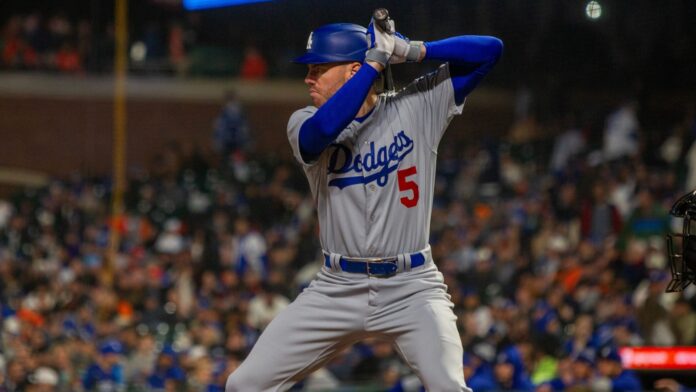
Freddie Freeman has experienced both sides of baseball’s championship equation. The Los Angeles Dodgers first baseman helped deliver consecutive World Series titles in 2024 and 2025, but their pursuit of a third straight championship ended with a four-game sweep by the Milwaukee Brewers in the National League Championship Series.
After the Dodgers’ 6-4 loss in Game 4, Freeman pushed back against the idea that expensive rosters can purchase championships. He emphasized that baseball remains unpredictable, regardless of the names on a team’s roster or the money invested in its players.
The defeat offered a timely reminder for a franchise that has committed enormous financial resources to building a championship contender. Despite their star power and spending, the Dodgers could not overcome Milwaukee, giving Freeman a clear example of why winning requires more than assembling an expensive collection of talent.
Freeman challenges the idea that money buys championships
Freeman addressed the spending debate after Los Angeles was eliminated by Milwaukee. He explained that championships are never guaranteed in sports and credited the Brewers for playing better throughout the four-game series.
His comments reflected the difference between building a talented roster and delivering results when the stakes are highest. Even established stars must execute under pressure, while opponents can capitalize on mistakes, timely hits and effective pitching.
The Dodgers entered the postseason hoping to complete a historic three-peat after winning the previous 2 World Series. Instead, Milwaukee exposed the limitations of relying on reputation and regular-season expectations when every postseason game presents a new challenge.
The Dodgers’ expensive roster could not prevent elimination
Los Angeles entered the 2026 season with another star-studded roster, strengthened by major additions, including closer Edwin Díaz and outfielder Kyle Tucker. The organization continued investing heavily in talent as it pursued another championship.
According to FanGraphs’ payroll estimates, the Dodgers entered 2026 among baseball’s highest-spending teams. Their financial commitment reflected an aggressive strategy built around retaining established stars while adding players expected to improve their championship chances.
However, the roster’s price tag did not guarantee postseason success. The Dodgers struggled to maintain their advantage against Milwaukee, and their championship defense ended before they could reach the World Series, despite having considerable talent and experience.
Milwaukee proved that roster construction matters
The Brewers entered the postseason without the same financial resources as Los Angeles, but their performance demonstrated the importance of building a balanced roster. Milwaukee finished the regular season with an MLB-best 103 wins before sweeping the Dodgers.
Manager Pat Murphy’s team combined effective pitching, timely hitting, and strong defense throughout the National League Championship Series. Rather than allowing Los Angeles to dictate the games, Milwaukee repeatedly responded when the defending champions appeared ready to take control.
The decisive Game 4 illustrated that resilience. Los Angeles built a 4-0 lead, powered by Shohei Ohtani’s three-run homer, but Milwaukee rallied and won 6-4. Garrett Mitchell delivered the go-ahead home run, while the Brewers’ pitching helped protect their advantage.
The Dodgers’ previous championships still matter
Despite the disappointing ending, Los Angeles has evidence that its spending strategy can produce results. The franchise won the 2024 and 2025 World Series, establishing itself as baseball’s most recent back-to-back champion before Milwaukee ended its title defense.
Freeman played a central role in the 2024 championship run. He delivered a historic walk-off grand slam in Game 1 of the World Series against the New York Yankees, helping the Dodgers secure an unforgettable victory.
The 2025 championship further demonstrated the roster’s potential. However, consecutive titles did not guarantee a third. The latest postseason reinforced Freeman’s point that previous success cannot determine future results, even when a team returns with much of its championship core intact.
Star power cannot replace postseason execution
The Dodgers’ lineup featured some of baseball’s most recognizable names, including Ohtani, Mookie Betts and Freeman. Their individual achievements created high expectations, but Milwaukee showed that individual talent does not automatically translate into a series victory.
Postseason baseball often turns on a handful of critical moments. A missed opportunity with runners on base, a defensive mistake, or a poorly timed pitching change can shift momentum quickly, regardless of how much a team spent assembling its roster.
Los Angeles also faced questions about the health and performance of key players during its playoff run. Ohtani’s pitching workload had been affected by injuries, while several prominent hitters struggled to produce consistently against Milwaukee’s pitching staff.
Baseball’s spending debate gains another example
The Dodgers’ elimination arrives as Major League Baseball approaches another important labor negotiation. The league’s collective bargaining agreement is scheduled to expire Dec. 1, 2026, creating renewed discussion about competitive balance and the possibility of a salary cap.
The Dodgers’ financial commitments have frequently placed them at the center of debates about spending disparities. Their ability to sign prominent players has helped create a roster capable of competing for championships, but their latest defeat offers critics another example of money’s limitations.
Milwaukee’s success strengthens the argument that player development, scouting, and effective roster management can help teams compete against wealthier opponents. Still, a single postseason result cannot establish that spending confers no competitive advantage; it simply demonstrates that financial investment alone cannot determine the champion.
Freeman’s perspective comes from championship experience
Freeman’s comments carry weight because he has experienced the work required to win at baseball’s highest level. His career includes a championship with Atlanta in 2021 and 2 titles with Los Angeles, giving him firsthand knowledge of different championship teams.
Those experiences also explain why he did not dismiss the Dodgers’ accomplishments after their elimination. Freeman expressed disappointment about falling short but maintained that the team had achieved meaningful things together and would need to regroup for another attempt.
His perspective offers a useful distinction between financial ambition and competitive achievement. Spending can help a franchise acquire talent, but teams must still develop chemistry, remain healthy, and perform under pressure when the postseason leaves little room for mistakes.
The Dodgers must turn disappointment into another opportunity
Los Angeles now faces an offseason of evaluation after its bid for a third consecutive championship ended earlier than expected. The front office must determine which weaknesses require attention and whether additional roster changes can improve the team’s chances next season.
The defeat does not erase the value of the Dodgers’ investment or the accomplishments of their recent championship runs. Instead, it highlights the uncertainty that makes baseball difficult to predict, even when a franchise appears to have assembled an overwhelming collection of talent.
Freeman’s message is ultimately straightforward: Money can help build a contender, but players must still win on the field. The Brewers earned their place in the World Series by outperforming Los Angeles, proving that championship success depends as much on execution as on financial resources.
Fun fact: Freddie Freeman became the first player in MLB history to hit multiple walk-off home runs in World Series games. His first came with a walk-off grand slam in Game 1 of the 2024 World Series, and he added another walk-off homer in Game 3 of the 2025 World Series.
TL;DR
- Freddie Freeman said sports offers no guarantees after the Dodgers were swept by the Brewers in the National League Championship Series.
- Milwaukee finished the regular season with 103 wins and defeated Los Angeles in 4 postseason games.
- The Dodgers’ expensive roster could not prevent their championship defense from ending before the World Series.
- Los Angeles won consecutive championships in 2024 and 2025, showing that heavy investment can help produce success without guaranteeing another title.
- The Brewers’ victory highlighted the importance of pitching, player development, roster balance, and postseason execution.
This article was made with AI assistance and human editing.
Read More From This Brand: