

From frozen ponds in Montreal to outdoor rinks in Minnesota, the harshest climates on the continent gave birth to the toughest franchises in hockey history. These cities did not just host the game. They built it from the ground up with bare hands and frozen breath.
Cold weather shaped more than playing styles. It shaped jerseys, nicknames, fan rituals, and generational loyalty. Cities buried under snow for months produced players, coaches, and owners who treated every game like a matter of civic pride. That DNA never left these franchises, no matter how far the league expanded.
Let’s take a closer look.
Frozen roots, where it all began
The first recorded indoor hockey game took place at Montreal’s Victoria Skating Rink in 1875. While British settlers brought field hockey traditions and Indigenous communities contributed stick-and-ball games, it was Canada’s frozen lakes and brutal winters that gave the sport its speed and grit. Cold was not an obstacle. It was the foundation.
When the NHL was formally organized in Montreal in 1917, all four founding teams were Canadian. The geography was no coincidence. Cities buried under snow for months produced players who could skate before they could ride a bike. The game grew because the climate demanded it, and the franchises that rose from those conditions carried that toughness into everything they did.

Montreal, a city that made hockey a religion
Founded in 1909 as a team for Montreal’s francophone community, the Canadiens became the oldest continuously operating professional hockey team in the world. Their nickname, the Habs, traces back to “les habitants,” the French settlers who built lives off the land in Quebec’s punishing cold. That identity of toughness and pride runs straight through the franchise to this day.
The Canadiens have won the Stanley Cup 24 times, more than any other franchise in NHL history. Bell Centre remains one of the NHL’s signature arenas, and in Montreal, attending a hockey game feels less like entertainment and more like a civic ritual.
Fun fact: The Montreal Forum, home of the Canadiens from 1926 to 1996, hosted over 50 inductees into the Hockey Hall of Fame across its seven decades of service.
Detroit, where hockey and industry became one
Detroit’s NHL franchise began play in 1926 as the Detroit Cougars. The Winged Wheel identity arrived in 1932, when owner James Norris renamed the team the Red Wings and linked the emblem to Detroit’s automotive heritage. A city defined by assembly lines and blue-collar labor found its perfect sports reflection in a team that valued toughness, work ethic, and consistency above everything else. Hockey and the Motor City were a natural match from the start.
In 1996, the Red Wings launched their “Hockeytown” campaign, building on a label already embraced by fans. The franchise has won 11 Stanley Cups, the most of any American-based NHL team. Even through decades of economic hardship, the arena lights never went dark. That is what a cold-weather city does for a franchise. It holds on.
Boston, the first American hockey city
When Charles Adams paid $15,000 for Boston’s NHL entry in 1924, the city was already well positioned to embrace the sport. Large French Canadian communities across New England helped strengthen hockey’s foothold in the region, and Bruins historian Richard Johnson later said Boston became “the sports equivalent of another province of Canada.”
The Bruins became the first American-based franchise in the NHL, and their identity was shaped entirely by Boston’s gritty, no-nonsense personality. Their logo, the Spoked-B, was designed as a nod to Boston’s nickname “The Hub,” with eight spokes connecting outward from the city’s center. Six Stanley Cup championships later, that blue-collar swagger is still the brand.
Fun fact: The Boston Bruins hold the NHL record for 29 consecutive playoff appearances between 1968 and 1996. No other franchise in league history has matched that streak of consistent postseason presence.
The original six and the cold-city blueprint
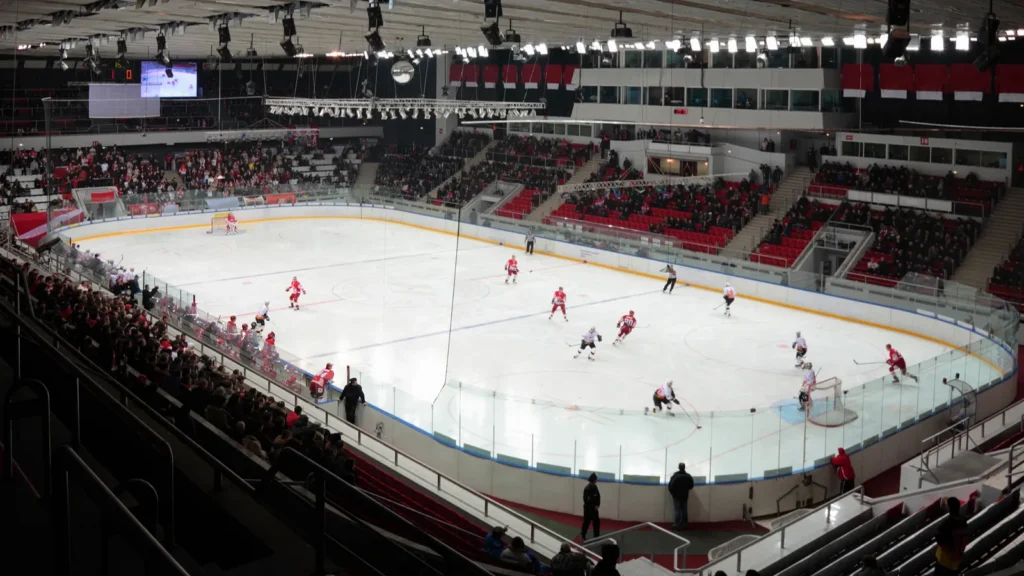
The Original Six era featured the Montreal Canadiens, Toronto Maple Leafs, Boston Bruins, New York Rangers, Detroit Red Wings, and Chicago Blackhawks. Every single one was planted in a cold-weather city. These teams held the league together through the Great Depression and World War II, creating a golden era of hockey known for its intensity and elite-only rosters with just 120 total NHL roster spots available.
The rivalries born during this era remain the emotional backbone of the sport. Montreal and Toronto battled not just for the Cup but for English-French supremacy in Canada. Detroit and Boston traded physical, grinding playoff series that became the stuff of legend. These matchups were possible because cold cities produced cultures where hockey was not entertainment. It was identity.
The cold city vs. the Sunbelt tension
In the 1990s, four NHL franchises relocated: Minnesota moved to Dallas in 1993, Quebec moved to Denver in 1995, Winnipeg moved to Phoenix in 1996, and Hartford moved to North Carolina in 1997. Those moves intensified debate over the league’s balance between traditional hockey markets and newer growth regions.
Under Gary Bettman, the NHL expanded its reach well beyond traditional hockey markets, and non-traditional markets have become a major part of the league’s modern story. Teams in Carolina, Dallas and Florida, among others, have built strong fan bases, youth programs and playoff success alongside the sport’s longstanding northern powers.
The legacy that cold cities left behind
The NHL now spans 32 franchises across North America, from Salt Lake City to South Florida. But when the league wants to celebrate its history and soul, it returns to cold-weather soil. The Winter Classic, the league’s marquee outdoor event, has been hosted most memorably in cities like Boston, Chicago, Detroit, and Minnesota. These settings do not need decoration. The atmosphere arrives naturally.
The Toronto Maple Leafs, Montreal Canadiens and Boston Bruins remain among the NHL’s most valuable franchises, while current valuation rankings also place the New York Rangers and Los Angeles Kings near the top. The league’s hockey-related revenue reached $6.3 billion in the 2023-24 season, up 8.6% from the prior year.

TL;DR
- Cold-weather cities like Montreal, Detroit, Boston, and Toronto literally invented NHL franchise identity through culture, not just competition.
- The Montreal Canadiens have won the Stanley Cup 24 times, the most in league history, built on Quebec’s French-Canadian cold-weather culture.
- Detroit’s “Hockeytown” identity was forged through a blue-collar automotive city that saw its toughness reflected in the Red Wings.
- The Original Six era featured exclusively cold-weather franchises, creating the rivalries and traditions that still define the sport.
This article was made with AI assistance and human editing.
If you liked this, you might also like: