NASCAR gave the fans exactly what they asked for, and the viewership numbers prove it did not work. The sanctioning body scrapped the “win and in” knockout-style format that had been in place for 12 seasons. Instead, they brought back an iteration of the “Chase” system used from 2004 to 2013, according to Beyond The Flag. Drivers, teams, and media outlets praised the move as a fix for the artificial drama of the old rules. Fans claimed they would return in droves once the “fake” championship battles were gone. Reality hit hard instead of the expected boom. Two of the early Chase races improved year over year, but the full 10-race postseason average finished down about 4 percent. Charlotte’s return to the oval was down roughly 15 percent from the prior Roval, while Kansas, Las Vegas, and Phoenix also posted declines. The Homestead finale itself was down 10.9 percent from the 2025 Phoenix championship race.
The Numbers Do Not Lie
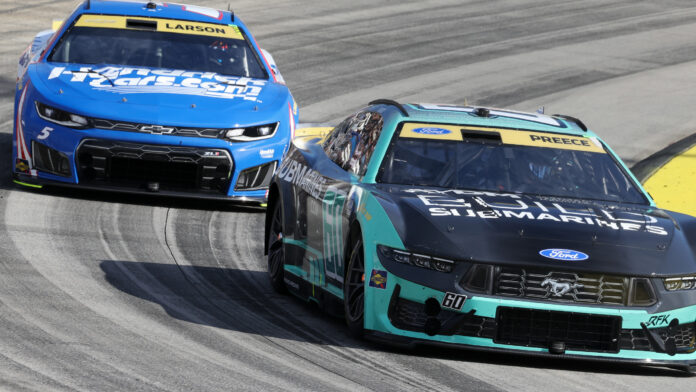
Viewership fell even when the track layout changed to please the crowd. Even though the oval hosted the event for the first time since 2017, Charlotte Motor Speedway’s fall race drew roughly 15 percent fewer viewers than the previous year’s Roval event, while Kansas and Las Vegas also posted single-digit declines. Phoenix’s 2026 Chase race was down about 24 percent from the nearest comparable prior-year slot. Jeff Gluck observed that the decrease was fairly small given the title was effectively settled before the race concluded. Kyle Larson secured his third Cup Series title after the opening stage, leaving the rest of the field fighting only for pride.
Excuses Fail to Explain the Decline
To account for reduced TV figures, NASCAR CEO Steve O’Donnell cited rivalry from college football and the NFL. He emphasized that season-long race attendance grew 5%, while attendance for children aged 12 and under climbed 12%. This growth in the stands does not match the drop on the screen. The excuse of “football being on” does not explain the annual decline, even though college football has always been a factor. Bristol Motor Speedway’s night race fell 5.7%, and the convenient “college football” excuse was cited repeatedly. “But football was on!” does not explain an annual decline, as noted by Beyond The Flag. The sport lost 2% of its overall television viewership across the entire 2026 season.
A Tribute to a Divisive Legend
While the ratings tanked, the sport found a moment of unity in memory of a driver who had passed away. The crowd at the season-ending ceremony in Miami cheered for Kyle Busch, who won the 2026 Most Popular Driver Award posthumously. Busch garnered 261,612 votes, a support level unmatched by any other driver, according to the National Motorsports Press Association. His wife Samantha accepted the trophy and spoke about his competitive nature. “Kyle never changed who he was to make people like him,” she said during her acceptance speech. Busch had tried to rally fans in the past and even called NASCAR to ask how close he was to winning the award before his death. Because Chase Elliott withdrew from the 2026 ballot to back Busch, the change in public sentiment was not accidental. The trophy fit because, as Samantha concluded, “There was no Rowdy without the fans.”