
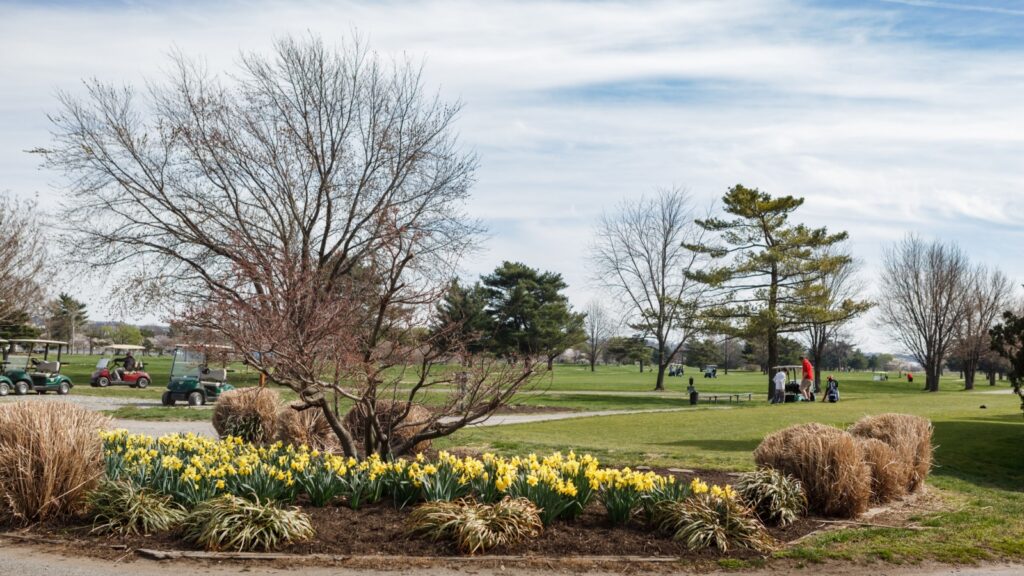
President Donald Trump wants to transform Washington, D.C.’s East Potomac Golf Links into a championship-level public course on Hains Point, reclaimed land in East Potomac Park. After touring the site with Interior Secretary Doug Burgum and golf architect Tom Fazio on June 28, Trump said work would begin Sept. 1 and promised to build one of the world’s greatest golf courses.
The plan faces an active federal lawsuit, a lengthy federal approval process, and engineering concerns tied to flooding, subsidence, and a high water table. Those concerns are underscored by the nearby East Potomac Pool renovation, a $14.35 million D.C. project that was halted after officials said unforeseen groundwater intrusion made continued construction unsafe and too costly.
A president’s ambitious vision for a golf course
Trump toured East Potomac Golf Links on June 28 with Interior Secretary Doug Burgum, golf architect Tom Fazio, and other officials. He described the existing course as “dilapidated, worn out, and very dangerous and outdated” and said the rebuilt public course could host major tournaments including the U.S. Open, Ryder Cup, and PGA Championship.
Burgum released a Fazio Design concept in May that showed a par-72, 7,660-yard, 18-hole course, a shorter 9-hole course, and expanded practice facilities. He said residents of the National Capital Region would receive affordable, discounted rates.
Earlier discussions floated ‘Washington National Golf Course’ as a possible name, but it has not been finalized. Officials branded the May design as ‘East Potomac Golf Links,’ and Trump’s June visit revealed plans differing from earlier renderings.
Hains Point’s high groundwater creates engineering challenges
East Potomac Park occupies reclaimed land created with material dredged from the Potomac River. The low-lying peninsula has a documented history of flooding and settlement, conditions that can complicate major excavation, drainage work, and changes in grade.
Those risks are not theoretical. During the nearby East Potomac Pool renovation, D.C. officials said the groundwater was significantly shallower than expected. The site repeatedly filled with groundwater, and officials halted the project after determining that continued construction had become unsafe and too costly.
Current critics of the golf overhaul are raising similar concerns. Hydrologist Peter Feldman has questioned the site’s suitability, while National Parks Conservation Association official Ed Stierli has said the project would also have to address the seawall.
A federal lawsuit adds another major obstacle
The DC Preservation League and 2 local golfers filed a federal lawsuit in February challenging the Trump administration’s actions at East Potomac Park. The plaintiffs allege that the government violated federal environmental requirements and the 1897 law establishing the park for public recreation as it moved toward a major overhaul of the golf course.
The lawsuit includes claims under the National Environmental Policy Act. NEPA requires an environmental review process for covered federal actions, but it does not automatically require a full environmental impact statement for every project; federal review can take different forms depending on the proposed action and its expected effects.
The case remains active. U.S. District Judge Ana Reyes declined in July to immediately block the project but pressed the administration for stronger assurances that major work would not begin before required approvals and court review could occur.
A failed pool renovation offers a warning
D.C.’s East Potomac Pool renovation began in winter 2018 with a budget that ultimately reached $14.35 million. The project was intended to replace the pool and deck and renovate the pool house.
By 2020, the D.C. Department of General Services said significant, unforeseen groundwater intrusion had made continued construction unsafe and too costly, leading officials to halt and deconstruct the project. DGS later said the groundwater was significantly shallower than expected and that the work site repeatedly filled with water.
The District later pursued a claim of more than $14 million against Hughes Group Architects over the project. The dispute proceeded through consolidated appeals before the D.C. Contract Appeals Board, which subsequently issued a final decision. The episode provides a documented example of the construction difficulties posed by high groundwater at Hains Point.
Federal oversight reviews have not yet occurred
Major changes to federally owned parkland in Washington typically involve review by the National Capital Planning Commission and the U.S. Commission of Fine Arts. Government lawyers told a federal judge in July that the East Potomac project would still have to go through a lengthy process that includes both bodies.
As of July 18, officials from both commissions told CNN that they had not received golf-course plans from the Trump administration for review. Neither commission holds a regular meeting in August, even though Trump has announced Sept. 1 as his intended construction start date.
That creates tension between Trump’s announced schedule and the federal review process that the government says remains ahead. It does not establish that the commissions have been permanently bypassed.
Fun fact: Hains Point is named for U.S. Army Corps of Engineers officer Peter Conover Hains, who designed the Tidal Basin.
Experts question the project’s engineering and review timeline
Trump has proposed starting work on Sept. 1, but that does not mean construction would finish within a month. Government lawyers said the project still requires reviews by federal planning and design agencies.
East Potomac’s narrow, flood-prone location also creates engineering challenges. Experts have raised concerns about subsidence, groundwater, and the seawall.
Fazio has said Trump wants the project completed quickly. Reports have cited summer 2028 as a target for opening the course, meaning Sept. 1 would mark the proposed start of work.

Local golfers and community groups push back
Some local golfers worry that upgrading East Potomac could make the affordable course less accessible. Interior Secretary Doug Burgum has promised discounted rates for local residents, but new prices remain unknown.
Save East Po supports keeping the park public and affordable. The group includes golfers, runners, cyclists, families, and other park users.
East Potomac also contains historic cherry trees, including some of Washington’s oldest Japanese flowering trees. Plans shown during Trump’s June visit left the future of the oldest grove, bike trail, and miniature golf course unclear.
What happens if the project moves forward
A major East Potomac redesign would need to account for groundwater, flooding, drainage, and the condition of the Hains Point seawall. The failed East Potomac Pool renovation illustrates how groundwater can disrupt construction at the site.
Separately, the National Park Service received $112.76 million to rehabilitate about 6,800 linear feet of seawall around portions of the Tidal Basin and along West Potomac Park. That project addresses settling, flooding, drainage, and future water-level risks, but it does not include the East Potomac Golf Links seawall.
The active lawsuit and outstanding federal reviews could affect Trump’s Sept. 1 target. As of Aug. 13, the project’s final construction timeline remains uncertain.
Little-known fact: The Girl Scouts moved into a permanent teahouse at Hains Point in 1924. After decades of changing uses and damage from a 1985 flood, the building was documented by the Historic American Buildings Survey in 1987 and demolished soon afterward.
TL;DR
- Trump plans to transform East Potomac’s public golf facility into a championship-level venue.
- The low-lying site has documented flooding, drainage, and groundwater challenges.
- A federal lawsuit challenges the project under environmental and preservation laws.
- Formal reviews by key federal planning and design bodies remain ahead.
If you liked this story, don’t forget to follow us for more exclusive content.
This article was made with AI assistance and human editing.
If you liked this, you might also like: