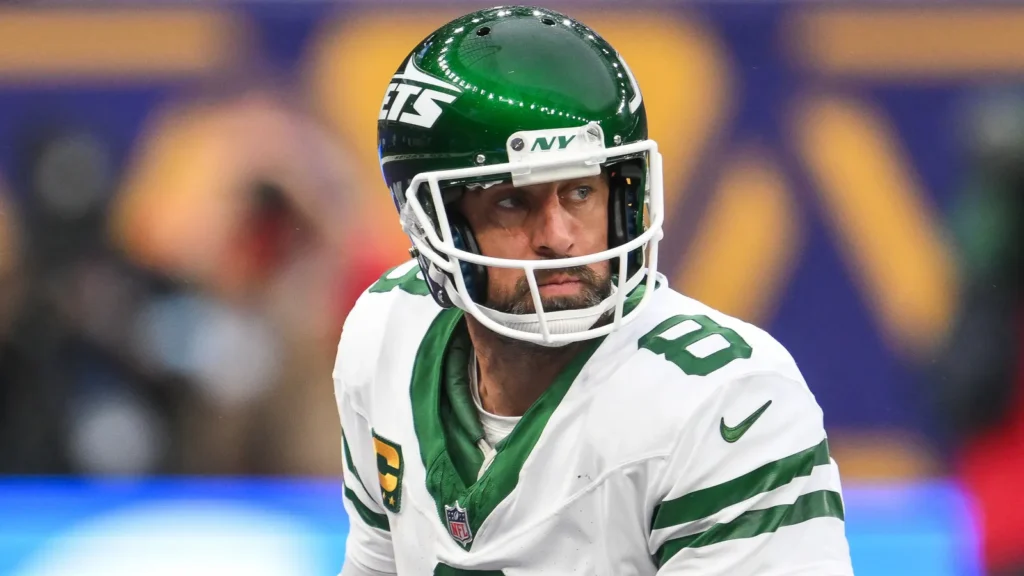
The NFL has reportedly highlighted a missed penalty involving Pittsburgh Steelers quarterback Aaron Rodgers as a clear example of an illegal hip-drop tackle. The incident occurred during Pittsburgh’s Week 4 matchup against the Cleveland Browns, when defensive lineman Adin Huntington brought Rodgers down without drawing a flag.
The league later used the play in an officiating video distributed to all 32 teams. NFL rules analyst Walt Anderson explained why the tackle met the criteria for a penalty. The development has renewed attention on how officials enforce a rule designed to reduce dangerous tackles. It also raises questions about consistency in game-changing situations.
NFL uses Rodgers tackle to explain the missed call
According to ProFootballTalk’s October 23 report, the league featured Huntington’s tackle in its weekly officiating video as an example of a play that should have been penalized. The video was distributed to NFL teams, giving coaches and players a direct explanation of the rule’s application.
Anderson, the NFL’s rules and officiating analyst, identified the tackle as an illegal hip-drop maneuver. He explained that the play displayed all four elements the league looks for when determining whether a defender has committed the foul.
“This is an illegal hip-drop tackle,” Anderson said in the video, according to ProFootballTalk. He added that the wrap, swivel, unweighting, and dropping or trapping of the legs were all clearly visible, making a penalty the correct ruling.
Why the uncalled penalty mattered to Pittsburgh
The tackle occurred on third down during the Steelers’ Week 4 game against Cleveland. Because officials did not throw a flag, Pittsburgh was forced to punt rather than receive the benefit of a defensive penalty that would have extended the drive.
Under the NFL’s rule, an illegal hip-drop tackle carries a 15-yard penalty and an automatic first down. Had officials made the call, Pittsburgh would have received a first-and-10 in favorable field position, putting the offense within long field-goal range.
The Browns ultimately defeated the Steelers 27-24, making the missed call especially notable in retrospect. The potential impact does not establish that a penalty would have changed the result, but the circumstances demonstrate why correct enforcement matters when a game is decided by a narrow margin.
What the NFL’s hip-drop rule actually prohibits
The NFL formally outlawed hip-drop tackles in March 2024 after team owners approved the change at the league’s annual meeting. The decision followed concerns that the technique placed excessive stress on runners’ lower legs and contributed to serious injuries.
The rule applies when a defender grabs a runner with both hands or wraps the runner with both arms, then unweights himself by swiveling and dropping his hips or lower body. The defender must land on and trap the runner’s leg or legs at or below the knee for the technique to meet the rule’s definition.

The rule does not prohibit every tackle involving contact with a runner’s legs. The specific combination of wrapping, swiveling, unweighting, and landing on or trapping the lower legs distinguishes an illegal hip-drop tackle from a conventional takedown.
Fun fact: Before penalty flags became standard, NFL officials used small horns attached to their wrists to signal fouls.
The league’s message extends beyond the original play
Anderson’s explanation emphasized that officials and players must recognize the complete sequence of movements rather than judge the tackle solely by its final position. That distinction is important because a defender can bring a runner down near the legs without necessarily committing the specific foul covered by the rule.
The league’s video also reinforces that missing a flag during live action does not automatically settle the matter. According to Anderson’s explanation, a prohibited tackle remains subject to additional discipline, including a fine, even when officials fail to penalize it during the game.
Huntington was fined following the play, according to ProFootballTalk’s report. That postgame discipline underscores the difference between the on-field ruling and the league’s subsequent review, although a fine cannot restore the field position Pittsburgh lost when the penalty went uncalled.
Why missed hip-drop calls remain an officiating concern
The Rodgers incident highlights the challenge of applying a technical rule at full speed. Officials must identify the defender’s grip, body movement, and landing position in a brief sequence, often while several players are moving around the ball carrier.
The league has previously faced similar questions about uncalled hip-drop tackles. In 2024, the NFL reviewed several plays that had not drawn flags during games, demonstrating that postgame evaluation could identify violations missed by the officiating crew.
Those earlier cases established an important distinction between recognizing a foul after reviewing video and identifying it during live action. The Rodgers example brings that distinction back into focus because the league’s own teaching material reportedly described the prohibited elements as clearly visible.
What the ruling means for NFL officiating
The league’s decision to feature the tackle in its officiating video provides a specific example of how the rule should be applied. Rather than relying on a general reminder, the footage connects the written definition to an actual play involving a quarterback under pressure.
For Pittsburgh, the incident remains part of a three-point loss against a division rival. For Cleveland, Huntington’s subsequent fine reflects the league’s assessment of the tackle, even though the Browns retained the benefit of the original on-field ruling.
The broader issue is consistency between the rulebook and its enforcement. The NFL has established a clear definition and a substantial penalty for hip-drop tackles, while the Rodgers incident illustrates how a missed call can affect field position and become a significant talking point after the final whistle.
TL;DR
- The NFL reportedly used Adin Huntington’s uncalled tackle on Aaron Rodgers as a textbook example of an illegal hip-drop tackle.
- NFL rules analyst Walt Anderson said all four elements of the prohibited technique were visible.
- The missed third-down penalty forced Pittsburgh to punt instead of receiving an automatic first down and 15 yards.
- Cleveland defeated Pittsburgh 27-24 in the Week 4 matchup.
- Huntington was fined after the play, according to ProFootballTalk.
- The incident has renewed attention on the difference between postgame discipline and consistent enforcement during games.
This article was made with AI assistance and human editing.
Read More From This Brand: