Two disputed roughing-the-passer penalties against Green Bay reignited debate over NFL officiating after Detroit’s 20-17 victory on October 25, 2026. Both drew scrutiny for their influence on pivotal Lions possessions in a tightly contested divisional game.
The league already uses replay assistance to correct certain penalty errors, but most roughing-the-passer judgments cannot be challenged. Sunday’s game illustrated the difference between watching a disputed play again and possessing the authority to reverse its call.
A late flag changes Detroit’s final drive
With the score tied 17-17, Lions quarterback Jared Goff found tight end Sam LaPorta for an 18-yard completion. Packers defensive tackle Karl Brooks was then penalized for roughing the passer with 2:45 remaining in regulation.
The 15-yard enforcement advanced Detroit from its own 45-yard line to Green Bay’s 40. Rather than changing the completed pass itself, the flag gave the Lions substantially better field position for a possession that determined the outcome.
Detroit moved into field-goal range, and Jake Bates converted a 22-yard attempt as time expired. The Lions improved to 4-2, while Green Bay fell to 4-3 and ended its three-game winning streak.
An earlier penalty extends another possession
The Brooks flag followed a separate roughing call against Packers edge rusher Brenton Cox Jr. in the third quarter. Cox made contact with Goff while fighting through a blocker as the quarterback released an attempted pass.
The throw fell incomplete, but the penalty gave Detroit an automatic first down and allowed them to continue. Television replays prompted questions about whether Cox had sufficient control of his movement to avoid making contact with the quarterback on the play.
That sequence was not Detroit’s only disputed third-quarter penalty benefit. An unnecessary-roughness flag against Devonte Wyatt also extended a possession, which ended with Goff finding Jameson Williams for a 10-yard touchdown that gave Detroit the lead.
Players and commentators dispute the decisions
Fox commentator Tom Brady challenged the fourth-quarter ruling against Brooks, saying, “That’s definitely not roughing the passer.” Rules analyst Dean Blandino also questioned whether the defender’s technique warranted a flag under the league’s protections for quarterbacks.
Packers safety Xavier McKinney criticized the officiating after the game, arguing that disputed flags interrupted defensive momentum. Head coach Matt LaFleur took a more restrained approach, acknowledging difficult calls without making them the sole explanation for defeat.
Their objections did not amount to an official finding that either roughing call was incorrect. Assessments made from television angles can differ from a referee’s real-time judgment, especially when several types of prohibited contact must be considered.
What the roughing-the-passer rule protects
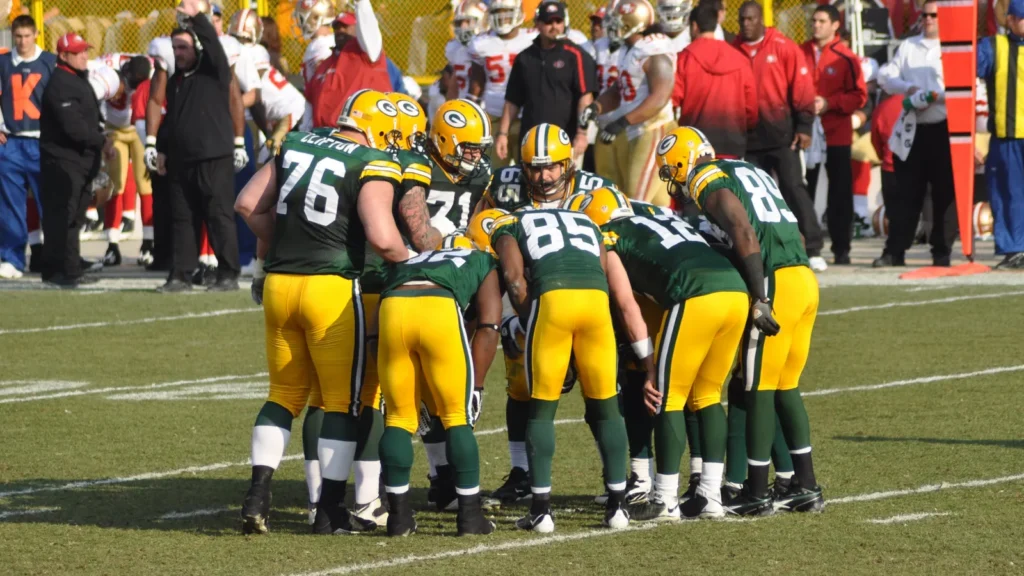
NFL rules give passers additional protection because throwing often leaves them vulnerable to contact. Officials evaluate timing, contact to the head or neck, low contact, and potentially avoidable force when applying those rules in live action.
A roughing-the-passer foul normally costs the defense 15 yards and awards the offense an automatic first down. That combination can extend a possession even when the quarterback’s pass is incomplete, and the defense initially appears to have succeeded.
The distinction between a legal tackle and a foul sometimes depends on positioning and timing. Video may clarify where a defender made contact, but camera angles cannot resolve every judgment about avoidable force or a player’s control.
Replay assistance already has limited authority
Under current NFL procedures, replay assistance can remove a roughing flag based solely on head or neck contact when video clearly establishes that the defender never touched that area. This narrow exception does not cover every tackle.
Coaches cannot simply challenge every roughing-the-passer call. Ordinary judgments about late contact or a defender landing on the quarterback remain outside that process, including before the two-minute warning when coaches may challenge other eligible rulings.
The league expanded its assistance in 2025 for certain objective-penalty mistakes, including specific facemask and horse-collar situations. That limited mechanism differs from giving video officials general authority to replace every on-field judgment about whether contact was excessive.
The NFL has considered additional video powers
In January 2026, league football operations officials discussed whether replay should identify player-safety violations that referees missed. Roughing the passer was among the categories considered for possible intervention, although discussion alone did not change the rules.
The 2026 rule changes did not establish unrestricted replay review of those calls. The earlier discussions therefore provide background to the current debate, not evidence that a new process for challenging every quarterback-protection penalty has been adopted.
Any permanent rule change would require support from at least 24 of the NFL’s 32 clubs. The competition committee studies possible revisions, including their effect on player protection, competitive balance and the administration of individual games.
Past experiments show the trade-offs
The NFL briefly permitted reviews of pass interference calls and noncalls during the 2019 season. The one-year experiment followed controversy over a missed interference call during the previous season’s NFC championship game between New Orleans and Los Angeles.
The league did not retain that arrangement for 2020. Its short lifespan illustrated the difficulties of expanding review to judgment-based penalties, particularly when officials and spectators disagree about the evidence required to overturn an initial ruling.
Supporters of broader roughing review can point to the costs of a questionable 15-yard penalty. Critics can argue that more stoppages and repeated examination of borderline contact would introduce fresh disputes without guaranteeing consistent decisions across games.
The game also exposed Green Bay’s other mistakes
The Packers were penalized eight times for 81 yards, including two roughing-the-passer calls. Through seven games, Green Bay had accumulated eight such penalties, while its opponents had received none for contact on Packers quarterbacks during passing plays.
Yet the officials were not the only factor in Sunday’s outcome. Rookie kicker Trey Smack missed a 26-yard attempt and had a 35-yard effort blocked, opportunities that could have changed the late-game situation for Green Bay.
A limited review system focused on clearly demonstrable contact errors could offer a middle ground between unrestricted challenges and current restrictions. Whether NFL owners favor any expansion remains unresolved, leaving the Packers-Lions dispute a relevant example.
Fun fact: The NFL first adopted regular-season instant replay in 1986, discontinued it in 1992, and restored the system in 1999. Early concerns included delays and coaches’ limited ability to request reviews.
TL;DR
- Detroit beat Green Bay 20–17 on October 25, 2026, after Jake Bates converted a 22-yard field goal as time expired.
- Roughing-the-passer calls against Karl Brooks and Brenton Cox Jr. drew criticism during and after the game.
- The NFL’s replay-assistance system covers specified, objectively verifiable errors rather than providing unrestricted review of every disputed penalty.
- Proposals to expand video review of player-safety penalties have prompted debate about consistency, game delays and officiating judgment.
- The controversy renewed questions about how the NFL should balance player protection, accurate officiating and uninterrupted play.
This article was made with AI assistance and human editing.
Read More From This Brand: