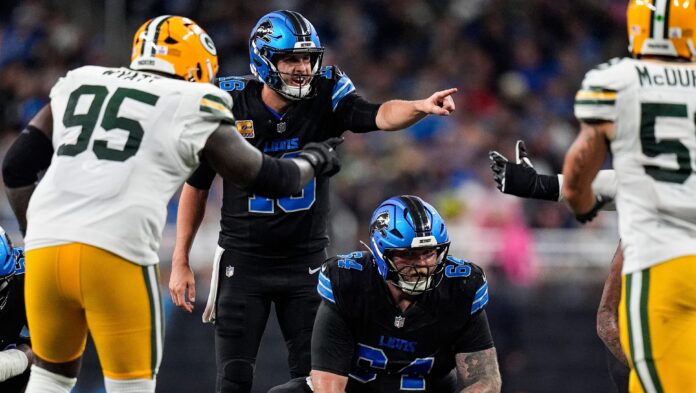
The Detroit Lions beat the Green Bay Packers 20-17 on Oct. 25, but the divisional matchup at Ford Field left Green Bay questioning more than the final score. Several disputed penalties, including roughing-the-passer calls and a personal foul, triggered strong reactions from players and fans.
The debate quickly turned toward a bigger issue: whether the NFL should change how certain penalties are enforced or allow more of them to be reviewed. Packers supporters argued that crucial decisions repeatedly hurt their team, while the officials offered explanations for some of the most contentious rulings.
Detroit still had to finish the game, and Green Bay had opportunities of its own. But the disputed calls gave the league another high-profile officiating controversy, with fans calling for greater consistency and more accountability.
Controversial penalties overshadow Detroit’s narrow victory
The Lions secured the 20-17 win with a 22-yard field goal by Jake Bates as time expired. The result followed a tense fourth quarter, but frustration over officiating became a major part of the postgame discussion.
Green Bay faced several costly flags, including two roughing-the-passer penalties against Detroit quarterback Jared Goff. The Packers also objected to an unnecessary-roughness call against defensive tackle Devonte Wyatt and other decisions that affected key possessions.
The penalties did not erase Green Bay’s missed opportunities. The Packers went 1-for-4 in the red zone and missed 2 field goals, leaving them with their own mistakes to address after a close divisional loss.
Karl Brooks’ late roughing call fuels fan anger
With the score tied at 17-17 and less than 3 minutes remaining, Goff completed an 18-yard pass to tight end Sam LaPorta. Packers defensive tackle Karl Brooks was then penalized for roughing the passer, giving Detroit 15 additional yards.
The flag moved the Lions into better field position during their decisive drive. Detroit eventually reached the range for Bates’ winning kick, making the penalty especially frustrating for Green Bay fans who believed the contact did not warrant a foul.
Online reactions included calls to make roughing-the-passer penalties reviewable. That proposal reflects a recurring complaint from football fans: a subjective judgment by officials can have a major effect late in a close game, with limited opportunity to challenge the decision.
Brenton Cox Jr. was also flagged for roughing the passer
Brooks’ penalty was not the only roughing call that drew scrutiny. Earlier in the game, Packers defensive end Brenton Cox Jr. was penalized after a third-down incompletion involving Goff, prompting further complaints from Green Bay supporters.
Packers coverage described Cox as appearing to be blocked into the quarterback, raising questions about whether the defender could reasonably avoid the contact. The play added to the team’s frustration over how the roughing rule was being applied.
Green Bay’s official website reported that the Packers had been called for roughing the passer 8 times this season, while Jordan Love had yet to draw such a penalty for his team. That contrast became another talking point, although the numbers alone do not establish inconsistent officiating.
Devonte Wyatt’s personal foul raises questions about the whistle
Another disputed moment came in the third quarter, when defensive tackle Devonte Wyatt was flagged for unnecessary roughness after tackling Lions receiver Amon-Ra St. Brown a second time. The play had become confusing because players said they had not heard a whistle.
Referee Alex Moore later explained that officials had ruled the play over before Wyatt’s additional tackle. Moore also acknowledged that he could not honestly say whether he heard a whistle, but said the second tackle with force was the reason for the penalty.
Packers coach Matt LaFleur argued that Green Bay’s defenders continued playing because St. Brown appeared to be getting up and moving forward. The penalty gave Detroit a first down, and the Lions scored a touchdown 2 plays later to take a 17-14 lead.
Jordan Love’s intentional-grounding penalty adds to the debate
Green Bay also questioned an intentional-grounding call against quarterback Jordan Love. The officials ruled that although Love was outside the tackle box, his pass did not reach the line of scrimmage or the area where his intended receiver, tight end Tucker Kraft, was positioned.
Moore explained that a quarterback outside the tackle box must throw the ball beyond the line of scrimmage or sufficiently near an eligible receiver. Simply directing a pass toward a target is not enough if the ball falls short of the required area.
The call pushed the Packers into a difficult down-and-distance situation, and Love threw an interception on the following play. Green Bay’s frustration centered on whether the pass should have qualified as an attempt to reach Kraft, but the referee’s explanation outlined the basis for the ruling.
Xavier McKinney speaks out after the loss
Packers safety Xavier McKinney was among the most outspoken players after the game. He criticized the officiating and said penalties on important drives were disrupting Green Bay’s momentum, reflecting the frustration shared by teammates and supporters.
McKinney also said he was not a fan of the officials’ performance. His comments drew attention because players generally face potential league discipline when publicly criticizing officiating, although the possibility of consequences did not stop him from voicing his concerns.
LaFleur took a more restrained approach in his postgame comments, emphasizing that his team needed to play through difficult calls. His response highlighted the challenge facing coaches: they can disagree with decisions, but must still correct mistakes and prepare for the next game.
Fans want more consistency and review options
Fans’ calls for rule changes focused largely on making roughing-the-passer decisions reviewable. Supporters argue that video review could help determine whether contact was avoidable, whether a defender was pushed into the quarterback or whether the penalty was justified by the play.
Any change would require the NFL to balance accuracy against game flow. Expanding reviews could help correct clear mistakes, but it could also create longer stoppages and new disputes over how much contact should count as roughing the passer.
The league already permits reviews for certain categories of plays and penalties, but not every personal foul can be challenged. Changing that framework would require a formal rules decision, not simply a reaction to one controversial game. No rule change was announced in the immediate aftermath of the Packers-Lions matchup.
The controversy leaves the NFL facing familiar questions
The Packers-Lions game renewed a familiar debate about officiating in a sport where a single flag can change field position, extend a drive or put a team in range for a game-winning score. Close games make those decisions particularly visible.
Still, disputed calls do not automatically mean officials acted improperly or that the result was determined by penalties alone. Green Bay’s missed field goals and red-zone struggles also mattered, while Detroit converted its late opportunity into the winning points.
The most practical takeaway for the NFL is the need for clear, consistently applied standards and credible explanations when major decisions are questioned. Whether the league eventually adjusts replay rules, the latest controversy has given fans another reason to demand greater transparency.
TL;DR
- The Detroit Lions defeated the Green Bay Packers 20-17 on Oct. 25, 2026, on Jake Bates’ last-second field goal.
- Two roughing-the-passer penalties and a disputed personal foul against Devonte Wyatt fueled criticism of the officiating.
- Referee Alex Moore explained the Wyatt and Love calls in a postgame pool report.
- Fans called for changes, including making roughing-the-passer penalties reviewable.
- No immediate NFL rule change was announced following the game.
Read More From This Brand: