


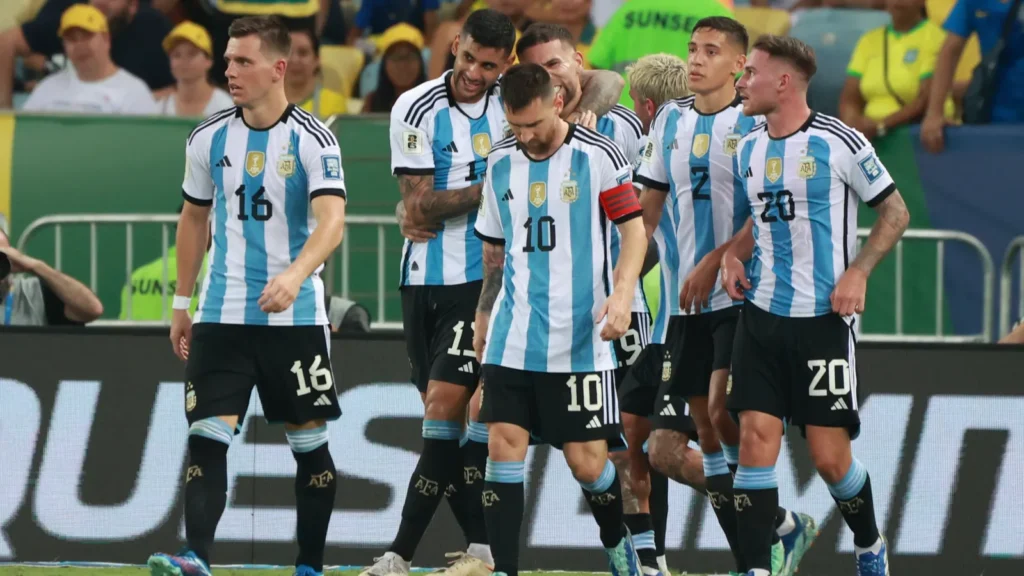
Argentina received FIFA’s approval to wear its navy blue away kit against England in the 2026 World Cup semifinal. The defending champions will set aside their traditional light blue-and-white stripes for the match, which kicks off Wednesday, July 15, at 3 p.m. ET in Atlanta.
The choice has attracted attention because Argentina wore dark blue in its memorable World Cup victories over England in 1986 and 1998.
A surprising kit request
Argentine journalist Gastón Edul first reported the request on social media earlier this week. He said Argentina had asked FIFA for permission to wear blue instead of its usual home colors for the match. FIFA subsequently approved the request, confirming that Argentina will wear its navy blue away kit against England.
The decision generated excitement and curiosity among Argentine fans on social media. England has been designated as the home team for the semifinal in Atlanta and will wear white. Argentina’s traditional light blue-and-white shirt could offer less visual contrast against England’s kit, giving the defending champions a practical reason to request their dark alternate strip.
FIFA seeks to create a clear contrast between the teams’ kits for players, officials, spectators, and viewers, including people with color-vision deficiencies. Still, many supporters have linked Argentina’s request to its history against England at the World Cup. Argentina wore dark blue when it eliminated England in 1986 and 1998, giving the color additional symbolic significance ahead of the semifinal.
Blue kit’s winning history
Argentina wore dark blue jerseys during two of their most celebrated victories over England on soccer’s biggest stage. The 1986 quarterfinal held in Mexico featured Maradona’s infamous handball goal and his stunning solo run. That match remains one of the most discussed and debated games in World Cup history today.
Fans still debate that unforgettable afternoon decades later across every corner of the soccer world. Argentina also wore blue back in 1998 when they beat England after a dramatic penalty shootout. That memorable match took place in France during that summer’s thrilling World Cup tournament years ago.
Beckham was sent off that day for kicking Diego Simeone during the tense second half. Supporters now hope this same shade of blue might bring similar good fortune once again this year.

FIFA confirms the decision
FIFA has since approved Argentina’s request, according to multiple reports covering the tournament closely this week. The team will wear its navy blue away kit for Wednesday evening’s semifinal match held in Atlanta. That particular strip has only appeared once in this tournament, during a group-stage win over Jordan.
Lionel Scaloni’s squad wore its traditional light blue and white shirt when it won in Qatar. That victory came during the 2022 World Cup final, capping off a memorable championship run.
FIFA also confirmed kit colors for the tournament’s other semifinal between France and Spain this week. Both nations are now preparing for their own separate and equally important matchup later this week. Kit decisions like these often carry symbolic weight for players and fans across every competing nation.
England sticks with white
While Argentina switches things up, England will wear all white for Wednesday’s highly anticipated semifinal match. That choice carries its own complicated history, since England also wore white during a controversial 1966 meeting. That earlier quarterfinal clash against Argentina took place many decades before this current tournament even began.
England also wore white during its recent quarterfinal win over Norway just days earlier this summer. That match required extra time before England finally secured its spot in this semifinal round. The team has largely stuck with white throughout this World Cup so far.
England previously wore red back in 2002 when Beckham’s penalty kick secured a win over Argentina. Manager Thomas Tuchel’s squad has worn that red kit only once in this tournament. This time around, England returns to its familiar and classic white look for the semifinal.
Fun facts: Argentina was the second country after Scotland to face England in a full international at Wembley Stadium, the hosts winning 2-1 in 1951.
Superstition fuels the excitement
Argentine fans have noticed several other coincidences beyond just the kit colors. The team finished atop its group unbeaten back in 1986, 1998, and now again this year. That exact pattern did not hold true before the tense 1966 meeting between these two nations.
That earlier meeting took place at historic Wembley Stadium in London, many years before this tournament. Diego Maradona scored both Argentine goals in 1986. Lisandro Martinez and Cristian Romero have both found the net during this tournament’s knockout rounds.
For superstitious supporters, these small details feel like meaningful signs pointing toward yet another famous victory. Many believe these small coincidences could carry real weight once the match finally kicks off. Whether or not superstition matters, both teams remain fully focused on the task at hand.
Messi reflects on rivalry
Lionel Messi spoke openly about facing England for the very first time in his long career. He said matches against strong teams always carry extra weight and add excitement for every player. Messi noted that his knowledge of the 1986 win comes only from watching old videos as a child.
He grew up watching those highlights as a young boy in Argentina, long before his own career began. The 39-year-old Ballon d’Or contender said his teammates stay focused no matter the opponent.
Messi added that his squad will try to arrive prepared and ready to compete at their best. The Argentine captain has faced nearly every major rival during his long and decorated international career. England remains one of the few storied opponents Messi has yet to face before this tournament.
A history-rooted rivalry
England and Argentina have not met at a World Cup since 2002, when Beckham’s penalty settled things. That tense group-stage clash between them still stands out as one of the tournament’s most memorable matches. Before that, the 1998 shootout and Beckham’s red card added even more tension to this rivalry.
The 1986 quarterfinal in Mexico still remains the most famous chapter of this storied rivalry. That unforgettable match featured both the Hand of God goal and Maradona’s celebrated Goal of the Century. Those two remarkable moments happened just four minutes apart during the same second half of play.
That memorable afternoon in Mexico City continues to shape how both nations view each other today. Decades later, the memory still shapes how fans approach every meeting between these 2 teams.
What is now at stake
Argentina reached this semifinal after beating Switzerland 3 to 1 during an extra-time thriller. That dramatic match took place last week in Kansas City, testing both teams’ patience and resolve. England advanced by defeating Norway 2-1, also needing extra time to settle it.
Both teams now arrive in Atlanta with strong momentum from their difficult knockout-round matches. Decades of shared soccer history and national pride now accompany both nations into this semifinal. A win would send either nation through to the World Cup final for the first time in years.
For Argentina, wearing blue adds a symbolic layer to an already massive occasion on the world stage. For England, breaking the pattern tied to that unlucky color would mean something truly significant.
Little-known fact: The first football match in Argentina was played by British railway workers in 1867.
TL;DR
- Argentina asked FIFA for permission to wear its dark blue away kit against England.
- FIFA approved the request, so Argentina will wear blue during Wednesday’s semifinal match.
- England will wear all white, the same color worn during the tense 1966 World Cup meeting.
- The semifinal is scheduled for 3 p.m. ET on Wednesday, July 15, 2026, in Atlanta, with both teams chasing a place in the final.
If you liked this story, don’t forget to follow us for more exclusive content.
This article was made with AI assistance and human editing.
If you liked this, you might also like: