
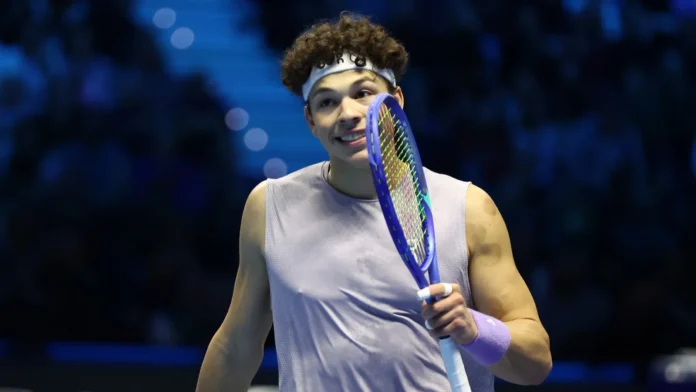
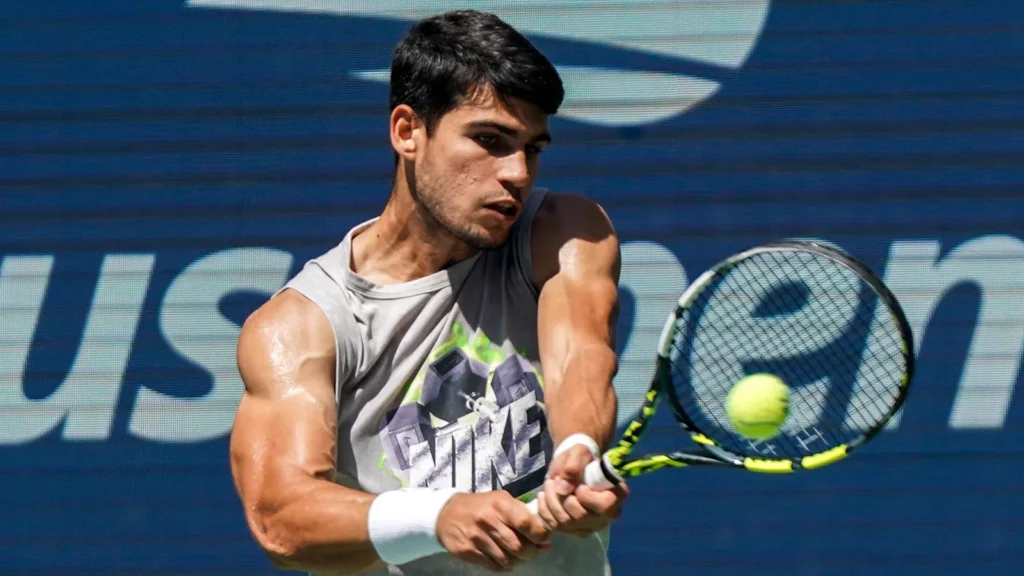
Tennis fans got a five-set thriller when Ben Shelton faced defending champion Carlos Alcaraz in the 2026 US Open quarterfinals. Shelton won 6-7(5), 6-1, 6-3, 1-6, 7-6(7) in 4 hours and 28 minutes, with the match ending at 3:33 a.m. ET.
The extraordinary finish renewed criticism of the US Open’s scheduling, which has faced scrutiny as matches increasingly extend into the early morning. Players and tournament officials have acknowledged the challenge of balancing competitive demands, television schedules, and the fan experience.
A match that broke the clock
Carlos Alcaraz entered Arthur Ashe Stadium as the defending US Open champion, while eighth-seeded Ben Shelton represented the American challenge. Their quarterfinal became a four-hour, 28-minute marathon that ended with Shelton winning a 10-point tiebreak in the fifth set.
Shelton prevailed 6-7(5), 6-1, 6-3, 1-6, 7-6(7), earning his first victory over a top-three opponent and reaching the US Open semifinals for the second time.
Setting a new late-night record
The five-set classic set a new US Open record for the latest finish, ending at 3:33 a.m. ET. The match began at 11:00 p.m. Tuesday after a long day of quarterfinal action at Arthur Ashe Stadium.
Earlier, Frances Tiafoe defeated Alex Michelsen in a five-set match that lasted 4 hours and 38 minutes, while Aryna Sabalenka also played a deciding-set tiebreak. The demanding schedule helped push the evening session deep into the night.
Shelton’s victory guaranteed an American man a place in the US Open final for the first time since 2006. It also kept alive hopes of an American men’s Grand Slam champion for the first time since Andy Roddick won the US Open in 2003.

A pattern years in the making
Late finishes happen at Flushing Meadows. Andy Murray and Thanasi Kokkinakis played until 4:05 a.m. at the 2023 Australian Open, and Emil Ruusuvuori and Daniil Medvedev finished at 3:39 a.m. in 2024.
Marquee matches at the US Open have crept later and later almost every single recent year, with finishes past 1 or 2 in the morning becoming a familiar, frustrating pattern for tired, exhausted tennis fans.
Tournament officials have publicly discussed this exact scheduling problem for many years now, admitting late nights were heavily reviewed after previous editions, yet no permanent fix has ever reached the court where matches are played.
Players have complained for years
Elena Rybakina once said she felt completely destroyed after a brutal, exhausting quarterfinal matchup in Montreal ended near three in the morning in 2023, echoing similar complaints that have followed professional tennis for many, many years now.
Iga Swiatek has also publicly called for much smarter, fairer match scheduling at major events, arguing that player health should matter more than filling a broadcast window with back-to-back marquee matches every night.
Doctors and coaches often warn that matches stretching well past midnight can also raise injury risk, since tired muscles react more slowly and recovery time before the next round shrinks dramatically for every single competitor involved.
Alcaraz camp slams the late finish
Alcaraz appeared to vomit into a towel during the fourth-set changeover as the four-hour, 28-minute match continued into the early morning. He recovered enough to win the fourth set before Shelton prevailed in the fifth-set match tiebreak.
Alcaraz’s trainer, Alberto Lledo, criticized the late-night scheduling online, saying that competing so late is not healthy for athletes. Alcaraz himself did not blame the schedule after the loss, instead saying he left the court happy and proud of how he fought.
Little-known fact: When Alcaraz was around 12, a family friend who owned Postres Reina helped pay for his trip to a junior tournament in Croatia. The same friend continued covering much of his early travel costs.
Fans already paid steep ticket prices
S Open ticket prices were already higher heading into the 2026 tournament. The average get-in price was reported at $311, compared with $262 at the same point in 2025, according to TicketData.
Resale prices for individual matches could be considerably higher, with some fans posting examples of sharply increased prices online. The tournament’s increasingly late finishes have also raised questions about the experience for fans attending or watching marquee matches.
Other Grand Slams handle nights differently
Wimbledon enforces a strict 11 p.m. curfew on every single match played there, largely out of respect for its nearby residential neighbors, a rule the US Open has never adopted at Flushing Meadows.
Roland Garros takes a very different approach, scheduling only a single match for its evening session, which typically begins around 8:15 p.m. and almost never runs past a reasonable hour.
These sharply contrasting policies clearly prove that late-night chaos is really just a choice, not an unavoidable fact of tennis itself, since other major tournaments successfully protect both players and fans.
Will the US Open ever change
Current tournament director Eric Butorac, who took over from Stacey Allaster in 2026, says he welcomes feedback on the issue, telling reporters he is all ears and genuinely open to exploring possible solutions. Butorac’s team already trimmed the day session matches from three to two, now starting at 11:30 instead of 11 a.m.
Bigger fixes like shot clocks or shortened scoring formats remain firmly off the table for now, meaning ordinary fans and players will likely continue to face similarly brutal, exhausting late nights for many years to come.
TL;DR
- Shelton beat Alcaraz in a 4-hour, 28-minute quarterfinal that ended at 3:33 a.m. ET, the latest finish in US Open history.
- Andy Murray and Thanasi Kokkinakis finished at 4:05 a.m. at the 2023 Australian Open, while Daniil Medvedev and Emil Ruusuvuori finished at 3:39 a.m. at the 2024 Australian Open.
- Alcaraz appeared to vomit into a towel during the match, while his trainer criticized the late-night scheduling.
- Elena Rybakina and Iga Swiatek have both publicly criticized late scheduling and called for greater consideration of player health.
- The average US Open get-in price was reported at $311 before the 2026 tournament, compared with $262 at the same point in 2025.
If you liked this story, don’t forget to follow us for more exclusive content.
This article was made with AI assistance and human editing.
If you liked this, you might also like: