

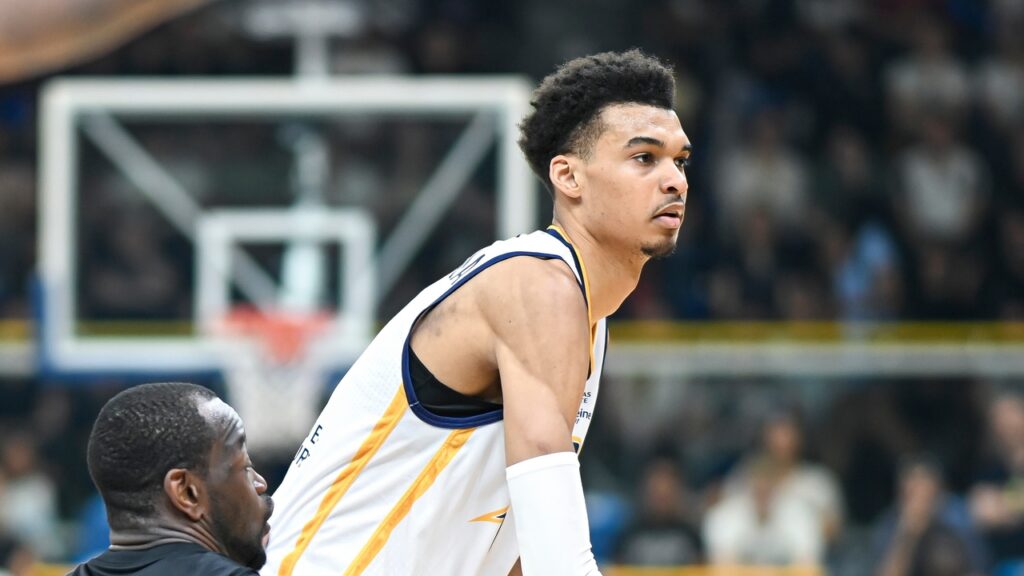
One postgame decision by Victor Wembanyama turned the 2026 NBA Finals celebration into a full-blown controversy. Instead of congratulating the New York Knicks after a painful Game 5 loss, the San Antonio Spurs superstar walked straight to the locker room. No handshake. No acknowledgment. Just silence and a tunnel.
Draymond Green called it out. Fans erupted on social media. Former players took sides. A single act of raw emotion from a 22-year-old became the loudest story to come out of New York’s first championship in 53 years.
The night that started it all
The New York Knicks defeated the San Antonio Spurs 94–90 in Game 5 on June 13, 2026, winning their first NBA championship since 1973. The celebration on the Frost Bank Center floor was electric and historic. But the cameras were not just following the champions.
Victor Wembanyama, at just 22 years old, walked straight into the locker room tunnel without shaking a single Knicks player’s hand. Most of his teammates followed right behind him. Some Spurs personnel stayed back to congratulate New York, but Wembanyama was not among the visible players doing so.

Social media exploded instantly
The backlash was swift and loud. Fans across social media called the exit “classless” and “soft.” Thousands of posts piled up within minutes of the final buzzer. The term “sore loser” trended across basketball fan communities almost immediately.
Several fans criticized the exit as poor sportsmanship, while others argued that handshakes are not required in the NBA.
Draymond Green weighed in fast
Few voices carry more weight in postgame drama debates than Draymond Green. He did not hold back. Green, reacting on Sunday morning, said plainly that skipping handshakes is “not good” and made clear he had a problem with it. His clip went viral within hours.
What made Green’s reaction sting more is his own complicated history with sportsmanship. Yet even he drew a line at skipping the handshake line. Green has previously said he “lost a lot of respect” for players who skip postgame handshakes after tough playoff losses.
Wembanyama spoke at the podium
To his credit, Wembanyama did not hide from reporters. He faced the media after the loss and was candid about the pain he was feeling. He acknowledged the series slipped away because of the team’s inability to finish when it mattered most. His words were honest and direct.
“This is the biggest lesson of my life,” Wembanyama said at the postgame podium. “I can’t tell exactly what the lesson is, but we’re learning from that, for sure.” He also said he planned to use the loss as fuel, telling reporters he was “pissed” knowing it could take roughly 100 games before the Spurs get back to the Finals.
History has seen this before
The Wembanyama situation instantly brought up one of the most talked-about moments in NBA playoff history. The 1991 Detroit Pistons, led by Isiah Thomas and Bill Laimbeer, walked off the court before Game 4 of the Eastern Conference Finals against Michael Jordan’s Bulls even ended. Several Pistons players walked off before the final buzzer, though Joe Dumars, John Salley, and coach Chuck Daly stayed to shake hands.
That moment became a defining image of the “Bad Boys” era. It is still brought up more than three decades later whenever sportsmanship is discussed. Isiah Thomas has actually argued that the post-game handshake tradition itself only became expected after that 1991 incident, sparked by Michael Jordan’s public criticism of the Pistons.
Jay Williams pushed back hard
Not everyone thought Wembanyama was wrong. Former NBA guard Jay Williams appeared on ESPN’s First Take and challenged the entire concept of mandatory postgame handshakes. He called it one of the worst unwritten rules in professional sports. His take split the internet right down the middle.
“I don’t have to do it because everybody does it. Nobody did make it a rule,” Williams argued. He went further, stating that athletes are paid to compete and win, not to like their opponents. His stance resonated with a large portion of basketball fans nationwide.
Fun fact: In 2023, Nikola Jokic did the exact opposite of Wembanyama. After the Nuggets won the NBA Finals, Jokic immediately sought out every single Heat player on the floor and shook their hands before celebrating with his own team.
What the series looked like
The Spurs were not blown out of this series. That is what made the exit so emotionally charged. San Antonio led by double digits in every single game of the five-game series. They had a stunning 29-point lead in Game 4, the largest ever surrendered in NBA Finals history.
Wembanyama finished Game 5 with 19 points, 14 rebounds, and five blocks. But he shot just 1-for-5 in the fourth quarter, and the Spurs managed only 18 points as a team in the final period. Jalen Brunson scored 45 points and was named Finals MVP.
What this means for his legacy
Wembanyama is one of the most gifted players the NBA has ever seen. At 7 feet 4 inches tall with guard skills, his ceiling is genuinely limitless. But the conversation around his sportsmanship has now become a thread in his public story. It will follow him until he proves otherwise.
The Spurs lost this series despite leading in every game. That fact alone shows how close they are to a championship. Wembanyama has the talent, the drive, and now the experience. The handshake moment will either be a footnote or a turning point, and that is entirely up to him.
Little-known fact: Wembanyama became the first unanimous Defensive Player of the Year winner this season and finished third in MVP voting.
TL;DR
- Victor Wembanyama walked off the court without shaking any Knicks players’ hands after losing the 2026 NBA Finals in Game 5.
- The Spurs lost 94–90 despite leading by double digits in all five games of the series.
- Some Spurs personnel stayed back to congratulate New York, but Wembanyama’s quick exit drew attention.
- Draymond Green immediately called the move “not good,” and his clip went viral.
If you liked this story, don’t forget to follow us for more exclusive content.
This article was made with AI assistance and human editing.
If you liked this, you might also like: