

ESPN faces backlash over religious sign ban
ESPN’s College GameDay faced criticism after its October 10 broadcast in Tuscaloosa displayed rules listing religious signs among prohibited items. The restriction prompted questions about religious expression, fan participation, and how consistently the rules were enforced during previous broadcasts.
ESPN reportedly said the policy had been in place for some time, while earlier footage showed fans holding signs with religious messages. The reports documented the restriction but did not establish when it was introduced or how it was enforced at earlier events.
The broadcast moved indoors
The controversy emerged during a broadcast shaped by severe weather concerns in Alabama. ESPN moved College GameDay inside Coleman Coliseum on the University of Alabama campus instead of using its usual outdoor setup.
The change followed forecasts associated with Hurricane Isaias, which also affected campus activities before the game. The indoor location placed the displayed rules on a video board above the audience, where viewers could see them.
Five categories appeared on the rules list
The posted “Pit Rules” listed five categories of prohibited signs or items, according to reporting about the photograph. These included vulgar, political, and religious signs, as well as signs containing website addresses, QR codes, or hashtag symbols.
Food and drinks were also prohibited in the pit, according to the displayed notice. The inclusion of religious signs drew particular attention because fans often use signs to share messages alongside football jokes and team support.
ESPN says the restriction was longstanding
An ESPN spokesperson told OutKick that the rule against religious signs had been in place for a while. That statement indicates the restriction was not necessarily introduced specifically for the Alabama-Georgia broadcast.
However, the available reporting does not establish when the rule was first adopted or provide a complete history of its enforcement. ESPN’s reported explanation also does not, by itself, answer why religious signs have appeared in footage from earlier broadcasts.
Earlier broadcasts featured religious messages
Reports examining previous College GameDay broadcasts identified examples of signs with Christian messages in the background. OutKick cited signs reading “Seek Jesus” and “Find Hope in Jesus” during earlier show appearances.
Those examples became relevant to questions about the consistency of the newly noticed restriction. However, their appearance on camera does not establish whether the signs were formally approved, overlooked, or displayed outside the designated pit area.
Interesting fact: Alabama has hosted ESPN’s College GameDay 22 times.
The pit has separate sign requirements
The pit is the designated audience area near the College GameDay broadcast set. ESPN’s pit rules restrict certain signs, including religious and political messages, vulgar material, and specified website or promotional markings.
The restrictions govern the designated pit area. A sign appearing elsewhere in the broadcast’s background does not, by itself, establish that it was admitted to the pit or approved by ESPN staff.
Interesting fact: ESPN’s flagship college football pregame show began in 1987 and has become a regular part of Saturday college football coverage.
Promotional signs were also restricted
The posted policy prohibited signs featuring website addresses ending in “.com,” QR codes, or hashtag symbols. Such restrictions distinguish ordinary fan messages from signs that may direct viewers toward websites, social accounts, or promotional material.
The same notice prohibited political signs and vulgar messages, showing that the policy covered more than religious expression. The available reporting does not explain the precise reasoning behind each category or identify who originally drafted the full set of rules.
The matchup brought national attention
The broadcast preceded a high-profile SEC game between No. 2 Georgia and No. 6 Alabama on October 10, 2026. ESPN scheduled College GameDay from 9 a.m. to noon Eastern time, with kickoff set for 7:30 p.m. Eastern.
The sign controversy added another topic of social media discussion ahead of the nationally followed matchup in Tuscaloosa. Georgia ultimately defeated Alabama 20-17 that evening, according to official game results.
Weather changed the event setup
ESPN moved College GameDay indoors to Coleman Coliseum because of expected severe weather ahead of the Alabama-Georgia matchup. ESPN announced the venue change before the October 10 broadcast and canceled its planned scavenger hunt and first-in-line prize giveaway.
Weather concerns also affected preparations for the football game, prompting changes to some activities around campus. The indoor setup explains where the sign rules were displayed.
Nick Saban returned to the broadcast
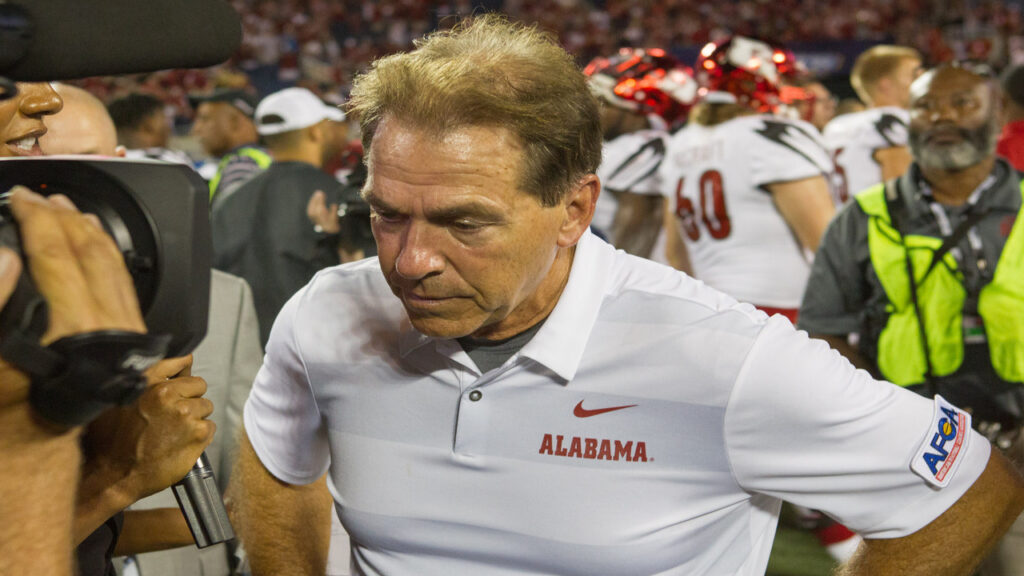
Former Alabama head coach Nick Saban joined College GameDay as an analyst during the October 10, 2026, broadcast. Former Alabama quarterback Bryce Young, the 2021 Heisman Trophy winner, joined the program as a celebrity guest picker.
Their appearances brought two prominent Alabama football figures to the show ahead of the Georgia matchup. ESPN’s announced lineup also included host Rece Davis and analysts Kirk Herbstreit, Desmond Howard, and Pat McAfee.
College GameDay entered its 40th season
The 2026 season marked the 40th season of ESPN’s College GameDay, a weekly program featuring college football previews, analysis, interviews, and fan participation. Its traveling broadcasts have become a regular part of major college football weekends.
ESPN reported that its October 3 episode from Iowa City averaged 2.9 million viewers, making it the most-watched October episode in the program’s history at that time. The Alabama sign controversy emerged during a season ESPN had described as record-setting.
ESPN drew criticism after Jordan Rodgers analyzed his brother Aaron’s performance on First Take. Check out why ESPN faces backlash over a controversial decision involving Aaron Rodgers’ brother.
Questions about consistent enforcement remain
The central documented issue is the presence of a religious-sign prohibition in the rules displayed at the Alabama broadcast. ESPN’s reported statement that the rule had existed for some time offers context, while earlier broadcasts showing religious messages have raised questions about how consistently the restriction was applied.
The available coverage does not specify when the rule was introduced or detail how it was enforced at previous events. ESPN’s stated explanation and the earlier footage provide context for the discussion surrounding the policy.
Lamar Jackson’s strong start put him in ESPN analyst Ben Solak’s early MVP conversation. Check out why Lamar Jackson gives ESPN analyst reason to make an early prediction.
What do you think about the restriction and how it was handled? Share your opinion in the comments and like this post if you want to see more sports discussions.
This slideshow was made with AI assistance and human editing.
Read More From This Brand: