
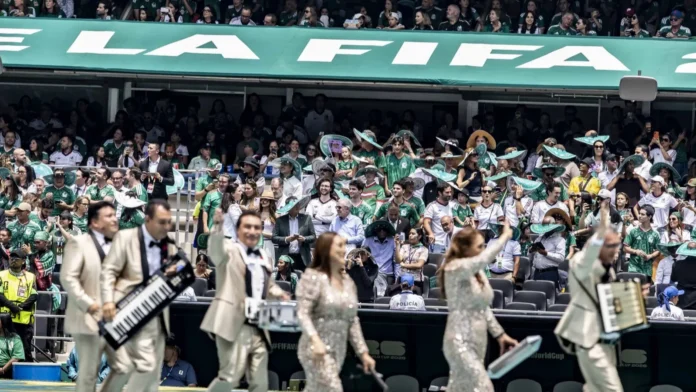
The 2026 FIFA World Cup was supposed to be the greatest party in football history. On June 11, 2026, Mexico City’s iconic Estadio Azteca lit up with music, color, and global excitement. Tens of thousands of fans from around the world gathered for a night that promised to be truly unforgettable.
But before the first whistle ever blew, the night took a shocking and deeply human turn. A serious medical emergency unfolded near the stadium gates, while protesters clashed with police outside the venue.
A night the world was watching
The 2026 FIFA World Cup opened at Estadio Azteca in Mexico City on June 11, 2026. Co-hosts Mexico faced South Africa in the first of 104 matches across the largest World Cup in history, featuring 48 teams across three nations. The tournament was always going to be enormous.
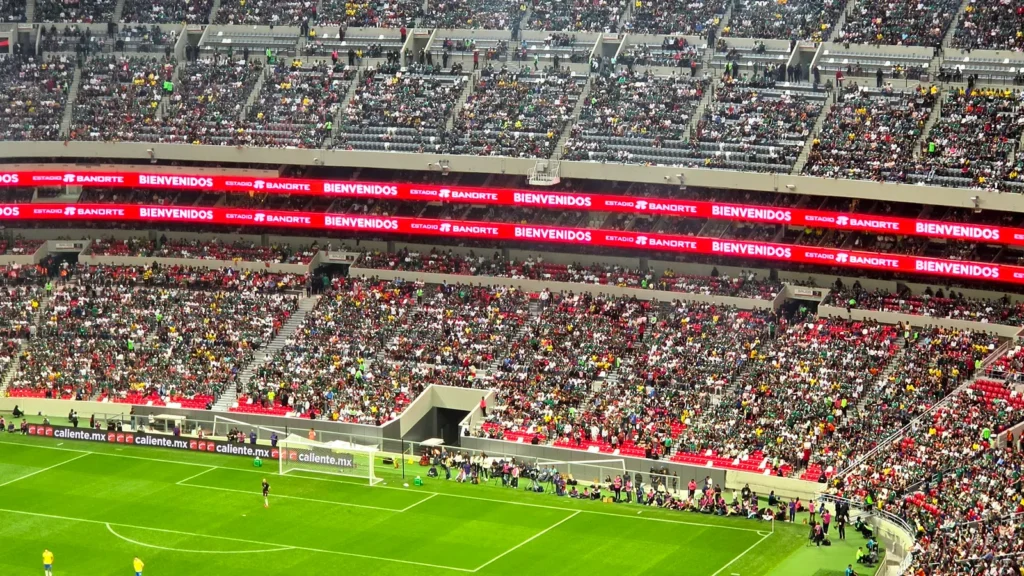
Mexico City was electric. Fans from dozens of countries poured into the 87,500-capacity stadium. The night promised music, goals, and memories. What nobody expected was a medical emergency that would cast a long shadow over the festivities.
The heart attack that stopped the world
Before kickoff, an 81-year-old German fan reportedly suffered a serious medical emergency near Gate 1 as thousands of supporters entered the stadium. He suffered a cardiorespiratory arrest as thousands of supporters streamed past him. His age was later confirmed by multiple reports, though Mexican authorities had initially not released details.
Red Cross staff, Civil Protection officers, and emergency personnel rushed to the scene. They performed CPR in a desperate effort to save his life. He was taken for medical treatment, but reports on his final condition conflicted. Mexico City’s SSC initially said he was stable, while some later reports claimed he had died.
What the authorities said
Mexico City’s Secretaría de Seguridad Ciudadana (SSC) confirmed the incident publicly. Their official statement noted that emergency responders had treated a foreign national who suffered a heart attack near the stadium. The SSC initially reported he had been stabilized and transported for specialist care before later reports confirmed his death.
Videos spread rapidly on social media. Footage showed paramedics surrounding the man on the ground, with bystanders gathered in shock. The images were a stark contrast to the celebration happening just meters away inside the stadium.
Chaos outside the gates
The medical emergency was not the only crisis unfolding outside Estadio Azteca that night. More than 18,000 protesters marched through Mexico City, representing public unions and human rights organizations. Many were relatives of people who had disappeared amid Mexico’s ongoing drug war.
A smaller group near the stadium broke away from the broader demonstrations and clashed with police near the gates. They smashed World Cup statues, hurled flares and rocks at riot police, and attempted to breach the stadium perimeter. Officers responded with batons, shields, and tear gas to push the crowds back.
Interesting fact: Estadio Azteca / Mexico City Stadium hosted the 1970 and 1986 World Cup finals and is now making history as a venue across three men’s World Cups.
Inside the stadium, a different world
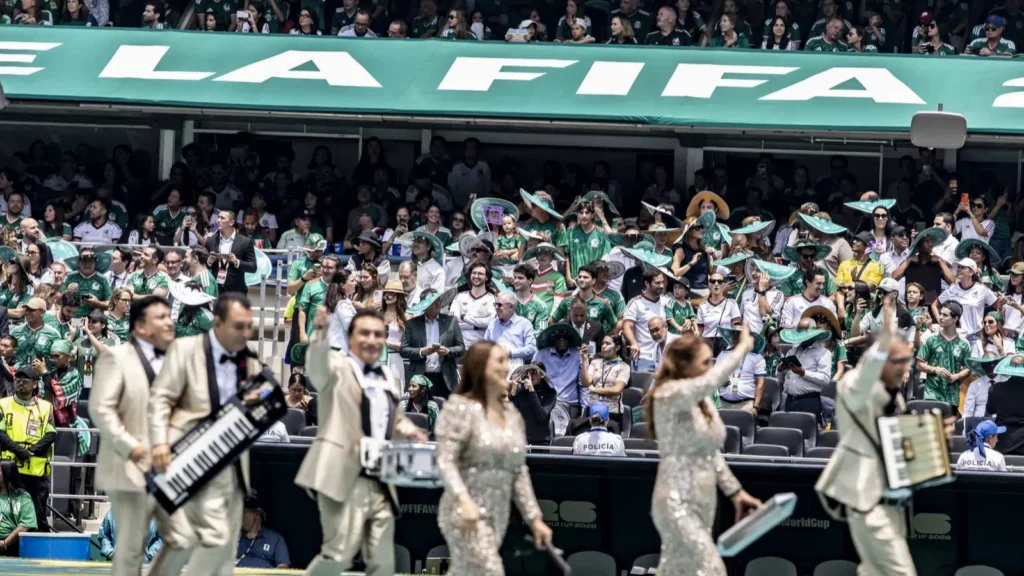
While chaos reigned outside, a stunning opening ceremony was underway on the pitch. Colombian superstar Shakira headlined the show, performing “Dai Dai,” the official tournament anthem, alongside Nigerian artist Burna Boy. Italian tenor Andrea Bocelli and K-pop star EJAE also performed the official FIFA anthem “DNA.”
World Cup Ambassador Salma Hayek Pinault welcomed the world to Mexico from the pitch. Flags from all 48 competing nations were paraded around the stadium. The crowd of nearly 87,500 roared with pride and anticipation for the match ahead.
Mexico wins, the stadium erupts
When the match finally kicked off, Mexico delivered. Julian Quinones opened the scoring in the ninth minute after being set up by Erik Lira. Veteran striker Raul Jimenez then headed home a second goal to seal a 2-0 victory over South Africa. Mexico City exploded into a sea of celebratory green.
It was a historic win for the co-hosts, who have long struggled to move past the Round of 16, a phenomenon Mexican fans call the “quinto partido” or fifth-match barrier. The win on home soil, in front of a packed Azteca, gave the nation genuine hope for a deep tournament run.
The Aztecs’ troubled recent history
The tragedy on opening night was not the first at the renovated Azteca. In March 2026, before the tournament, a 27-year-old man named Adrian Gomez Vasquez fell to his death from the VIP box section during a Mexico vs. Portugal friendly. Authorities said he had been intoxicated and was attempting to jump between levels.
The incident raised serious concerns about crowd management and safety at the venue. FIFA had required all stadiums to pass rigorous safety inspections before hosting matches. The back-to-back tragedies have now placed Azteca’s safety record under renewed scrutiny.
The stakes have never been higher
This World Cup is not just football’s biggest party. It is also FIFA’s most lucrative business venture ever. FIFA projects a record $13 billion in revenue across its 2023 to 2026 commercial cycle, with $8.9 billion generated by the tournament itself. The jump from Qatar 2022’s $7.6 billion is the largest single-edition revenue increase in World Cup history.

Prize money also hit a record $871 million total, with the winning nation set to collect $50 million. That is a 50% increase compared to Qatar 2022, when Argentina earned $42 million for lifting the trophy. The financial stakes mirror the emotional ones on the pitch.
TL;DR
- An 81-year-old German fan died of a heart attack near Gate 1 at Estadio Azteca before the World Cup opener on June 11, 2026.
- Emergency responders performed CPR on scene, but he was pronounced dead at a nearby hospital.
- Over 18,000 protesters clashed with riot police outside the stadium, many demanding answers over Mexico’s drug war disappearances.
- Inside, Shakira, Burna Boy, Andrea Bocelli, and EJAE headlined a spectacular opening ceremony.
If you liked this story, don’t forget to follow us for more exclusive content.
This article was made with AI assistance and human editing.
If you liked this, you might also like: