

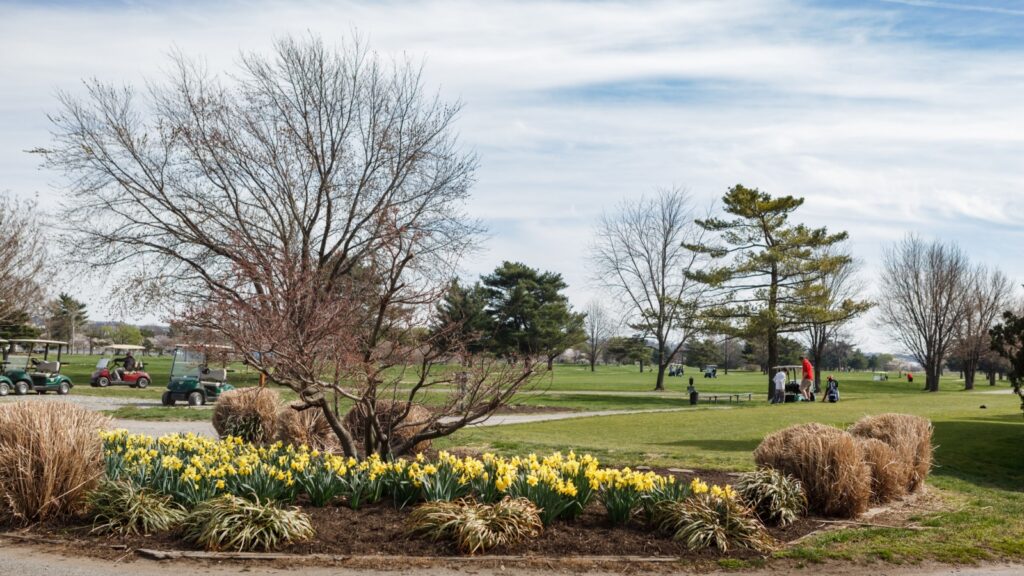
President Trump wants to turn East Potomac Golf Links, a public golf course on federal parkland in Washington, into a championship-level venue. Photos from his June 28 tour showed redesign plans that appear to stretch across much of the East Potomac peninsula, raising concerns about cherry trees, a riverside trail, miniature golf, and open parkland.
The project is already being challenged in federal court by preservation advocates. A judge has required the government to give advance notice before removing more than 10 trees, while questions remain about funding, timing, public access, and how much of the park’s shared recreational character could change.
A bold vision for a rundown course
President Trump toured the East Potomac Golf Links on June 28 this year. He called the property dilapidated, worn out, and dangerous during his visit. Standing beside Interior Secretary Doug Burgum and golf architect Tom Fazio, he announced plans to build a championship-level golf course for the capital city.
Trump said the finished course could host the U.S. Open, the Ryder Cup and the PGA Championship. He promised it would be one of the greatest golf courses anywhere in the world. Critics note that tournament sites are chosen years ahead, so the promise remains far from guaranteed right now.

The leaked blueprint that sparked backlash
Photographs from the June 28 tour showed Trump holding architectural drawings. The images revealed a redesign stretching across nearly the entire East Potomac peninsula. Reporters noticed the plans appeared far larger than anything federal officials had previously described publicly, raising immediate questions about transparency and the project’s scope.
A firestorm exploded on social media once the blueprint circulated widely. One Threads user asked how such damage could be allowed to happen. Others invoked the phrase “everything I touch, I kill,” pointing to a pattern of changes across the nation’s capital under this administration in recent months and years.
What could disappear from Hains Point?
The redesign drawings raise questions about several long-standing public amenities, including a riverside bike trail, miniature golf, and open areas for picnicking, fishing, cycling, and other recreation. If built as shown, the plan would reduce East Potomac from its current 3-course, 36-hole layout to a single 18-hole championship course.
That would cut the number of golf holes in half while expanding the golf course to roughly 50 acres of parkland now used for other public activities. The exact final impact remains uncertain because the project is still facing legal, environmental, and public access issues.
The cherry trees at the center of the storm
The cherry tree grove within East Potomac Park dates back to Japan’s gift of thousands of flowering trees in 1912. The blossoms remain among the most recognizable and beloved landmarks in Washington. Millions of visitors travel to the capital each spring specifically hoping to see the pink blooms in person.
A federal judge already stepped in to limit potential damage. In May, Judge Ana Reyes ordered that officials could not remove more than 10 trees without advance notice. The order came after preservation advocates warned that the administration might quietly begin clearing land before the ongoing lawsuit reached its final conclusion.
Little-known fact: Japan’s first cherry tree shipment to Washington in 1910 was destroyed after officials found it infested with disease and insects.
Trump’s claims about neglect and danger
Trump has defended the redevelopment by pointing to what he described as deteriorating irrigation infrastructure, damaged trees, and poor playing conditions at East Potomac Golf Links. His comments framed the project as a needed upgrade for a historic public course.
During court proceedings, federal officials said no immediate major renovation work was planned and that a safety assessment was underway. East Potomac’s first 18 holes were built between 1918 and 1923, making the course one of Washington’s oldest public golf facilities.

Lesser-known fact: East Potomac’s golf courses date back to the early 1900s, making them among the oldest public golf facilities still operating in the United States today.
The federal lawsuit challenging the project
The D.C. Preservation League and 2 local golfers filed a lawsuit challenging the federal government’s handling of the East Potomac project. They argue that the administration is moving toward a major redevelopment without completing the required legal, environmental, and public review processes.
The dispute also grew from the government’s decision to move material from the White House East Wing demolition project to East Potomac Park. Preservation advocates say the step heightened concerns that the site could be reshaped before the public receives full details or has a chance to review.
Who is paying for the makeover?
Officials have not released a final public price tag for the East Potomac redesign. The project report says funding details remain unclear, although the administration has discussed relying heavily on private contributions to improve public golf facilities.
That uncertainty is part of the public debate. Supporters argue private money could reduce the burden on taxpayers, while critics say residents still deserve clear answers about cost, access, fees, public land use, and who benefits from the finished course.
What comes next for East Potomac Park
Trump has said renovation work would begin on September 1 this year. That timeline remains uncertain given the ongoing lawsuit and the judge’s insistence on advance notice. No final environmental assessment or public review process has been released, leaving many important details about the project still unresolved at this time.
East Potomac remains federal public land shared by golfers, cyclists, anglers, and tourists alike. A championship redesign that touches trails, trees, and shoreline access is a major public land decision. Residents and visitors alike deserve full details about what could be lost before any construction actually begins in this area.
TL;DR
- Trump toured East Potomac Golf Links on June 28 and promoted plans for a championship-level course.
- Photos from the tour showed drawings that appeared to expand the redesign across much of the East Potomac peninsula.
- Amenities that could be affected include a riverside trail, miniature golf, cherry trees, and roughly 50 acres of parkland used for recreation.
- If built as shown, the plan would cut East Potomac from 36 holes to 18, a 50% reduction.
- Washington’s cherry trees trace back to Japan’s 1912 gift, and some East Potomac trees are central to preservation concerns.
- The D.C. Preservation League and 2 local golfers sued, arguing the government bypassed required review for federally protected public parkland.
If you liked this story, don’t forget to follow us for more exclusive content.
This article was made with AI assistance and human editing.
If you liked this, you might also like: