
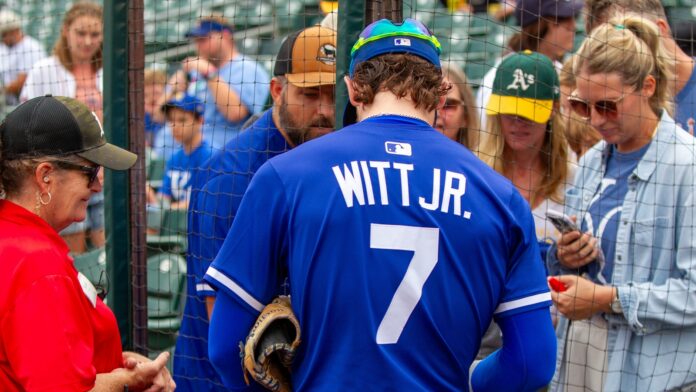

Why he still sits on top
Bobby Witt Jr. still sits atop fantasy middle infield rankings because his speed, batting average, and projected power continue to outvalue the field.
That top spot matters because fantasy rankings reward category balance, not one cold patch. Witt still offers speed, batting average help, and enough projected home run juice to remain the safest middle infield anchor.

The speed still changes everything
Even when the power feels less explosive, Witt’s speed keeps his fantasy floor unusually high. The recent updates still treat that base-stealing threat as one of the biggest reasons he remains such a valuable roster cornerstone.
That matters more than frustrated managers sometimes admit. A middle infielder who can swing a category with his legs gives fantasy teams weekly breathing room, especially when other hitters on the roster come with more volatile profiles.

Batting average keeps the floor steady
Witt’s value is not built only on highlight plays or stolen bases. The ranking also reflects his steady batting average profile, which gives managers dependable production even when the long balls are not showing up in bunches.
That kind of stability is a major separator at middle infield. Players with louder streaks can be exciting, but Witt’s ability to help in average keeps him useful even when one category temporarily looks lighter.

The power projection has not disappeared
The key fantasy point is that analysts still project Witt for roughly 20 to 30 home runs, which means a quieter stretch has not changed the larger expectation surrounding his bat.
That is why patience matters so much. Fantasy managers are being reminded not to confuse a temporary slowdown with a true collapse, especially when the rest-of-season outlook still matches preseason power expectations.

Patience is the smartest move
The update’s broader lesson is simple: there is no strong statistical reason to panic on Witt. Analysts are urging managers to hold steady instead of reacting emotionally to the idea of a power slump.
That advice stands out in fantasy leagues because impatient managers often create bad trades. Moving off a player with Witt’s balanced profile can turn a short-term worry into a season-long mistake.

His prime makes the bet easier
Part of Witt’s appeal is timing. Analysts are treating him like a player squarely in his prime, which makes it easier to believe this is still the version fantasy managers should trust for the rest of the year.
That context matters because fantasy confidence often depends on age and trajectory. Witt is not being graded like a fading veteran or an uncertain prospect, but as an elite player still in growth-friendly territory.

The competition is strong, but he still leads
Witt’s ranking looks even stronger when viewed next to the names behind him. The statistics still place him above De La Cruz and Tatis, two stars with huge ceilings and plenty of category juice themselves.
That says a lot about trust. Managers can dream on explosive alternatives, but Witt remains the preferred fantasy answer because his profile combines upside with fewer weekly questions than most middle infield rivals.

Others are rising, which sharpens his value
The middle infield pool is getting more interesting as other names gain momentum. The update points to risers and rebound candidates, which makes staying above that pack more meaningful for Witt.
Instead of hurting his case, that deeper competition helps explain it. If fantasy managers still prefer Witt while the position gets stronger around him, it shows how secure his all-around profile really is.

Bogaerts shows why steady production matters
One reason the update feels useful is that it highlights players like Xander Bogaerts outperforming expectations. That gives managers another reminder that fantasy value is often about rounded production, not just headline power.
Witt fits that lesson perfectly, only with a much higher ceiling. He offers the same stabilizing effect fantasy managers crave, but with game-changing speed and stronger long-term upside attached to it.

Prospects do not change his current grip
The broader middle infield picture also includes young names such as Caleb Bonemer and Kevin McGonigle. That future depth is real, but it does not change Witt’s current fantasy value.
If anything, that contrast helps. Prospects carry intrigue, but Witt already gives managers proven category coverage at the major league level, which is why he remains the safer investment in redraft formats.
Fun fact: Bobby Witt Jr. became the first shortstop in MLB history with multiple 30-homer, 30-steal seasons, which helps explain why fantasy managers stay patient even when the home runs cool off.

He changes how rosters can be built
Having Witt at shortstop or second base creates flexibility across the rest of a fantasy roster. Because he already supplies speed and average stability, managers do not need to chase those traits elsewhere.
That opens cleaner paths to roster construction. Instead of forcing risky steals, pickups, or batting-average repairs, managers can target power bats, pitching depth, or upside plays in spots where volatility is easier to manage.

Market volatility makes him even more useful
Fantasy baseball gets messy when managers overreact to short samples, hot streaks, and trade rumors. In that kind of market, a player like Witt becomes even more valuable because his category mix cuts through the noise.
That is a big reason the ranking still looks right. While others rise and fall with changing narratives, Witt keeps offering the same core fantasy promise of speed, average, and bankable rest-of-season upside.
Two-way superstar Shohei Ohtani has consistently defied expectations by excelling as both a hitter and an elite pitcher for the Los Angeles Dodgers. Explore the advanced recovery metrics and mound progress that suggest Ohtani is ready to dominate once again.

Why the power slump has not knocked him down
The simplest answer is that Witt’s fantasy case was never built on home runs alone. His top ranking survives because his speed, batting average, and projected power still create the best middle infield package.
So even if the power has felt quieter than some managers hoped, the full picture remains strong. Bobby Witt Jr. is still No. 1 because fantasy baseball rewards complete players, and few are more complete.
Aaron Judge has already cemented his legacy as a regular-season titan, but his postseason narrative remains unfinished. Explore the specific strategic shifts the Yankees believe will finally propel their captain to a World Series ring this October.
Bobby Witt Jr. may not be crushing home runs at his usual pace, but the public still sees him as fantasy baseball’s top middle infielder. Do you think his speed and average make him the safest star to build around right now?
This slideshow was made with AI assistance and human editing.
Read More From This Brand: